Before Europe Dared
Bismillah…
Some of the most meaningful history between Aceh and the Netherlands
is found only when you start looking.
Not in school textbooks.
Not in the headlines.
But in the quiet spaces between what we were told –
and what actually happened.
I grew up knowing Aceh as the land my ancestors came from.
I did not know that long before the Dutch colonial era,
the Sultanate of Aceh had already recognized the Netherlands as an independent nation.
Not the other way around.
Multatuli himself recalled this in 1872:
“When the Dutch struggled for independence from Spain,
the Kingdom of Aceh was the first to recognize the Netherlands as an independent nation.”
At a moment when much of Europe itself was still unwilling to acknowledge Dutch independence,
a sultanate at the far edge of the Malay world had already extended that recognition.
Sit with that for a moment.
A kingdom in the Indian Ocean recognizing the sovereignty of a nation on the other side of the world –
before Europe dared to do the same.
But there is another reason this history interests me.
The Netherlands was not shaped by one dramatic moment.
Its character grew through conditions that had to be faced repeatedly.
Water.
Wind.
Land that could disappear beneath the sea.
Trade routes that had to be understood.
Ships that had to cross uncertain waters.
Systems that had to work-not because they were beautiful,
but because people depended on them.
This is where the Netherlands begins to reveal something about itself.
Not through grand declarations.
But through a practical relationship with reality.
You cannot negotiate with the sea.
You can only learn its patterns, understand its movement,
build what is needed, and maintain it.
Over generations, that kind of life teaches a civilization a certain clarity:
See what is there.
Understand what must be done.
Then build.
That quality would become part of the story I encountered when
I began looking more closely at Aceh and the Netherlands.
Because Aceh, too, knew how to engage the world.
But it did so from a different place.
A Civilization That Knew Where It Stood
The Sultanate of Aceh was never a region waiting to be discovered.
It was a sovereign Islamic civilization that had been engaging the world long
before European powers arrived in Southeast Asia.
At its height, Aceh competed with the Sultanate of Johor and Portuguese Malacca
for influence over trade through the Strait of Malacca.
Its ships sailed between Arabia, India, China, the Ottoman world, and Southeast Asia.
The court of Aceh became a renowned centre of Islamic scholarship and commerce.
It was known as Serambi Mekah – the Porch of Mecca –
where the Qur’an and classical Islamic texts were translated into Malay,
shaping generations far beyond its shores.
Aceh maintained diplomatic relations.
It appointed ambassadors.
It signed international treaties.
It engaged foreign powers as an equal rather than as a subject.
The spices were never just spices.
They were part of a larger language of exchange-spoken
between ports, courts, merchants, scholars, and rulers long
before colonization tried to rewrite the conversation.
And this is where the two histories begin to meet.
The Netherlands had learned to read the conditions around it.
Aceh had learned to stand within the world without losing its place in it.
Both understood that survival required more than strength.
It required knowledge, discipline, and a clear sense of where one stood.
Aceh and the Netherlands: The Ambassador Buried in Amsterdam
When I first read this, I had to stop.
Tuanku Abdul Hamid, head of the Aceh delegation,
became the first ambassador from Southeast Asia known to visit Europe.
He died in Amsterdam on 10 August 1602 and was buried there with full honours.
On his gravestone in Middelburg,
he is remembered as the head of the delegation of Sultan Alauddin Riayat Shah,
representing the Sultanate of Aceh before the courts of Europe.
A man from the land of my ancestors, buried in the Netherlands more than four centuries ago.
Before Indonesia existed.
Before the phrase “Southeast Asia” had even entered common language.
History connects what maps keep separate.
And standing between these two civilizations, I begin to notice something.
History does not only tell us what happened.
It shows us what people repeatedly chose to do when circumstances required an answer.
The Netherlands would build around the conditions it faced.
Aceh would continue to defend its place in the world.
Both would negotiate.
Both would trade.
Both would encounter powers greater than themselves.
And eventually, both would reveal their character under pressure.
That is where this story becomes more than history.
It becomes a question.
What does a civilization reveal about human character when reality refuses to bend?
When a Guarantee Was Sold
For much of the nineteenth century,
Aceh’s independence was protected under the Anglo-Dutch Treaty of 1824.
It was not a small detail.
It was part of the political balance that allowed Aceh to remain an independent power in the region.
During the 1820s, Aceh was also a significant commercial power,
supplying a substantial share of the world’s pepper.
A sovereign state.
Internationally connected.
Economically significant.
And yet sovereignty can be more fragile than it appears
when its protection depends partly on agreements made elsewhere.
In 1871, Britain concluded a new treaty with the Netherlands,
relinquishing its previous position regarding Aceh in exchange
for other strategic interests, including shipping rights.
Two years later, the Dutch invaded.
A treaty had changed.
And with it, the political conditions surrounding an entire civilization.
The full story of that diplomatic bargain belongs to another chapter-
the history of Britain’s relationship with Aceh.
When I first understood this part of Aceh and Netherlands history,
I did not feel anger.
I felt something quieter.
The kind of stillness that comes from realizing how fragile sovereignty can become
when its protection depends on someone else keeping their word.
Here, what stays with me is simpler.
A people can be sovereign.
They can trade across oceans.
They can send ambassadors.
They can be recognized by distant powers.
And still, circumstances beyond their control can suddenly alter the ground beneath them.
That is one of the quieter lessons of sovereignty.
It is not only the ability to rule oneself.
It is also the responsibility to understand
how fragile the conditions surrounding that freedom can become.
Even after that guarantee disappeared,
Aceh chose to defend its sovereignty for another thirty-one years
rather than accept a decision made without its consent.
Aceh and the Netherlands: A War They Did Not Expect
When the Dutch arrived in Aceh,
they did not encounter an empty space waiting to be administered.
They encountered a civilization that already knew diplomacy, commerce,
scholarship, warfare, and international politics.
Aceh had defended its position in the region for centuries.
It had competed with other powers for control of the Strait of Malacca.
It had fought the Portuguese.
It had negotiated with distant empires.
And it had developed its own understanding of what sovereignty required.
The Dutch invasion therefore became more than a military campaign.
It became a prolonged encounter between two different ways of responding to pressure.
The Dutch brought organization, military power,
and the confidence of a colonial state expanding its control.
Aceh responded with resistance.
Not a single battle.
Not one dramatic final stand.
But years.
Decades.
Thirty-one years of war.
That duration matters.
Because resilience is often romanticized when we look backward.
We imagine courage as one great moment when someone decides to stand.
But thirty-one years suggests something less cinematic.
It suggests repetition.
Loss.
Adaptation.
Return.
The decision to continue after the previous day did not produce victory.
There is a stubbornness in that.
Not the loud kind.
Not stubbornness for its own sake.
But the refusal to allow pressure to decide one’s identity.
The Aceh War became one of the most difficult conflicts in Dutch colonial history.
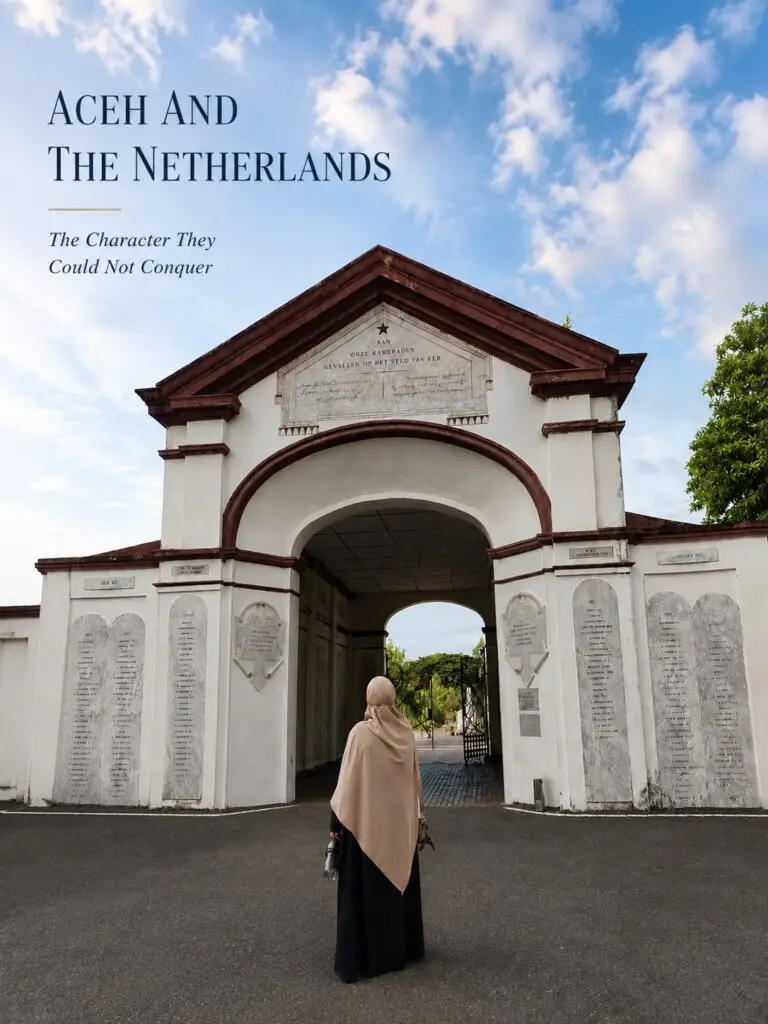
Around 2,200 Dutch soldiers now lie buried in Kerkhof Peucut–
the largest Dutch military cemetery outside the Netherlands.
And yet the war was not simply a story of one side advancing and the other disappearing.
The Dutch did not simply walk away.
Nor did Aceh simply disappear.
Both sides adapted to the realities of a war that proved far more difficult than expected.
There is something worth noticing in that.
Practicality does not always mean the absence of ideals.
Sometimes it means learning to face reality as it is.
To assess.
To adapt.
To reorganize.
To return.
To find another way forward.
That is one reason the Dutch character has so often been associated with practicality:
a landscape shaped by water leaves little room for pretending that reality will negotiate.
A dike does not stand because someone admires it.
A ship does not cross an ocean because its builders hope it will.
Things have to work.
And when they fail, they have to be repaired.
There is something quietly Dutch in that way of facing reality.
Not romanticizing the difficulty.
Not pretending the conditions are different.
Simply asking:
What is actually here?
What needs to be done?
And what must we build so that we can continue?
But Aceh reveals another form of resilience.
Its resistance was not simply an inability to adapt.
It was also a refusal to surrender something it considered fundamental.
And that distinction matters.
Because resilience does not always look like rebuilding.
Sometimes resilience looks like remaining standing.
What the War Left Behind
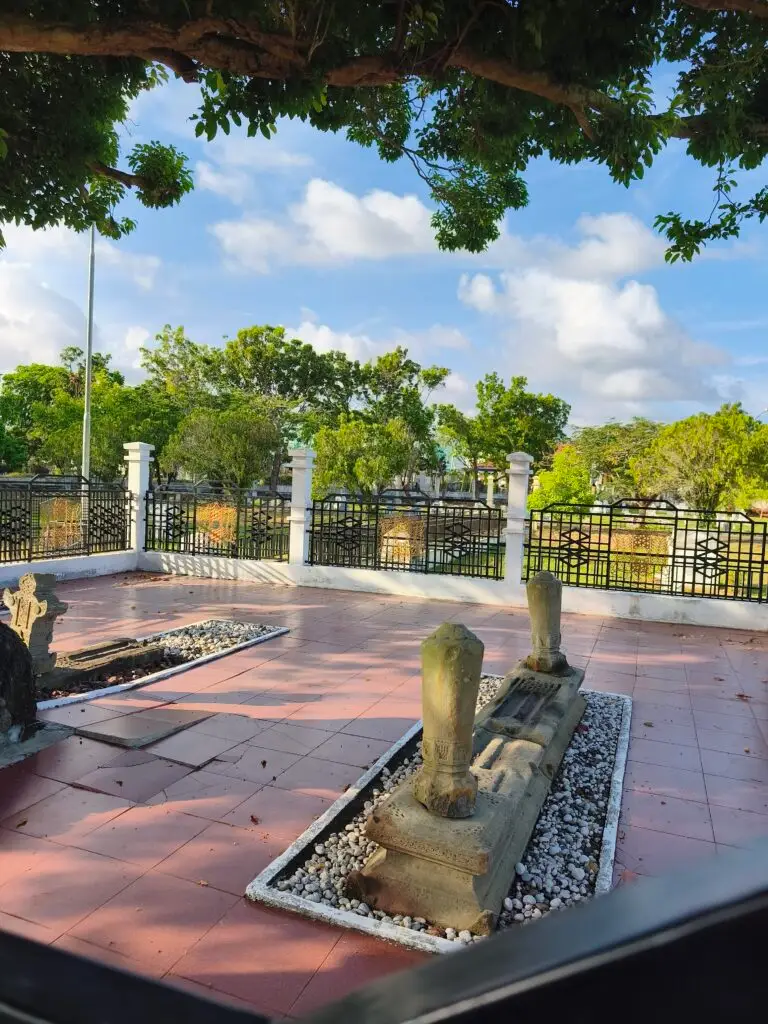
Today, around 2,200 Dutch soldiers lie buried in Kerkhof Peucut in Banda Aceh.
It is one of the largest Dutch military cemeteries outside the Netherlands.
There is something unsettling about that geography.
A Dutch military cemetery stands in the heart of the land
where the Dutch fought for decades to establish control.
The landscape itself remembers what power alone could not make simple.
Walking through history from a distance, it is easy to reduce wars to winners and losers.
But cemeteries make that language harder to sustain.
They return history to human beings.
Young soldiers.
Families.
Names.
Bodies.
Lives that ended far from home.
And on the other side were Acehnese families who also carried the cost of the war.
This is where I want to be careful.
The purpose of studying civilization is not to turn suffering into mythology.
Nor is it to romanticize resistance.
History asks us to hold more than one truth at the same time.
Power can be organized.
Resistance can be principled.
War can produce courage.
And war can also leave wounds that outlive the people who began it.
This is why remembrance matters.
Not to remain trapped in the past.
But to prevent the past from becoming too simple.
A Grave in the Centre of That Cemetery
At the center of Kerkhof Peucut lies the tomb of Meurah Pupok,
the only son of Sultan Iskandar Muda.
He was sentenced to death by his own father after committing adultery.
Being buried there was itself part of the punishment.
A Sultan who would not exempt his own son in order to uphold justice.
The story is striking not because it gives us a perfect ruler.
It gives us a difficult question about principle.
What does a person do when the one who has violated the law is someone he loves?
And what happens when responsibility demands something personally painful?
The story has stayed with me.
Not because it is severe.
But because it reveals something deeper than military strength.
Long before kingdoms are remembered for their victories or defeats,
they are quietly shaped by the principles they choose to protect.
That is why some civilizations remain recognizable long after their power has faded.
Not because they always prevailed.
But because they refused to abandon the values that defined them.
For me, this is where the historical story becomes an inner one.
Because civilizations are not revealed only by what their armies accomplish.
They are also revealed by what they believe should restrain power.
The Dutch story brings us toward one kind of character:
clarity about reality.
The Acehnese story brings another:
clarity about what must not be surrendered.
These are not opposites.
A civilization needs to know both:
what can be changed,
and
what must be protected.
That distinction is one of the quiet foundations of character.
And when I look again at the long history of Aceh and the Netherlands,
I find myself returning to that distinction.
Because history is not only a record of what people did.
It is also a record of what they were unwilling to abandon.
The Character They Could Not Conquer
The Dutch eventually established colonial control over Aceh.
But control is not the same as conquest.
A map can change.
A government can change.
A treaty can be rewritten.
A military force can occupy territory.
But there are things that cannot be measured so easily.
The willingness of a people to remember who they are.
The values they refuse to abandon.
The stories they continue to tell long after the people who lived them are gone.
What remained when the power had changed hands?
That question takes me back to the Netherlands.
Because the Netherlands, too, reveals something about character through what remained after pressure.
A civilization shaped by water could not afford to live entirely through idealism.
Reality had to be faced as it was.
Land had to be reclaimed.
Water had to be managed.
Trade had to function.
Ports had to remain connected.
Systems had to be maintained.
And when something failed, it had to be rebuilt.
There is nothing particularly romantic about that.
That is precisely why it is worth noticing.
Resilience does not always announce itself.
Sometimes it looks like people returning to the same work the next morning.
Repairing what broke.
Strengthening what weakened.
Changing what no longer worked.
And continuing.
Clarity Is Not the Absence of Difficulty
The Netherlands is often associated with directness, pragmatism, and clarity.
But I do not think clarity means having an easy path.
If anything, clarity becomes most valuable when the path is difficult.
A flat country surrounded by water does not offer the luxury of ignoring conditions.
The sea is not persuaded by emotion.
The wind does not adjust itself to human plans.
A dike either holds or it does not.
A ship either reaches the port or it does not.
A system either works or it needs to be changed.
There is a groundedness in that.
This is one reason the Dutch character can feel understated.
There is little need to make survival sound heroic
when survival is simply part of the work.
You assess the conditions.
You make the calculation.
You build.
You maintain.
And when necessary, you build again.
That kind of resilience has no need for applause.
It is practical because reality requires practicality.
It is persistent because the problem does not disappear simply because you are tired.
And it can appear stubborn because some realities cannot be negotiated away.
This is the Netherlands I want to remember.
Not a romanticized nation of perfect systems.
Not a civilization without contradiction.
But a people whose history reminds me
that clarity can become a form of resilience.
To see things as they are.
To respond to what is actually in front of you.
And to continue building without needing the world to applaud the effort.
What Aceh and the Netherlands Reveal
And yet, the story becomes more interesting when Aceh enters the picture.
Because Aceh reveals something different.
The Netherlands had to learn how to respond to conditions.
Aceh had to know where it stood.
The Netherlands built against water.
Aceh resisted against a power that sought to redefine its sovereignty.
The Netherlands developed habits of adaptation.
Aceh developed a fierce attachment to principles it considered worth defending.
Neither story should be reduced to a formula.
Neither civilization was perfect.
Both contained contradictions.
Both experienced power.
Both experienced loss.
Both changed over time.
But history allows us to observe the patterns.
And beneath those patterns lies something I have come to care
about more than the events themselves:
character.
What do we become when reality refuses to cooperate?
Do we deny it?
Do we adapt?
Do we compromise?
Do we resist?
Do we rebuild?
Do we preserve?
And the harder question:
How do we know what should change-and what should remain?
That question belongs not only to civilizations.
It belongs to us.
What History Asks of Us
I do not study history because I want to remain in the past.
The past is already gone.
What has happened cannot be rewritten by our feelings about it.
But history can change the way we see the present.
It can show us patterns that are difficult to notice when we are standing too close to our own lives.
It can reveal how decisions made generations ago continue to shape the world we inhabit today.
That is why civilizations matter.
They are not merely collections of old buildings, treaties, wars, rulers, and dates.
They are accumulated choices.
Ways of seeing.
Ways of responding.
Ways of remembering.
Ways of deciding what deserves to be protected.
We inherit more than land.
We inherit stories.
And sometimes, within those stories, we inherit questions.
The Netherlands asks me about clarity.
Aceh asks me about sovereignty.
And together they ask something larger:
What kind of person do I become when I learn to see reality clearly?
Why I’m Beginning Here
Human beings are complex.
We are shaped by the civilizations that came before us,
the families that raised us, the experiences that quietly formed us,
and the choices we continue to make.
To understand a human being more fully,
it is not enough to look inward alone.
Sometimes we also need to look outward –
to families, communities, civilizations, and nations –
to notice the patterns that have shaped the world around us.
That is one reason I keep returning to stories like Aceh and the Netherlands.
Not because history alone changes us.
But because history often reveals the values
that quietly shaped a civilization long before they became visible in its people.
In the Qur’an, Allah says:
“O mankind, We created you from a male and a female,
and made you into nations and tribes so that you may know one another.”
And elsewhere:
“And We have certainly honoured the children of Adam.” (QS. Al-Isra 17:70)
Every civilization.
Every people.
Every sovereign land.
Honoured before history had a chance to complicate it.
That is why I have come to see civilizations differently.
They are not merely stories of kingdoms, wars, or borders.
They are part of the architecture of human character.
Long after monuments weather.
Long after empires disappear.
Long after maps are redrawn.
The values a civilization nurtures often continue to echo through the generations that follow.
Why Aceh and the Netherlands
I begin this journey with the Netherlands because its story is deeply intertwined with my own country,
and especially with my home province, Aceh.
The relationship between Aceh and the Netherlands shaped centuries of history.
Yet beyond the wars and treaties, I find myself asking a quieter question.
What patterns quietly shaped the collective character of these nations?
And what might they reveal about us today?
That is the question I hope to carry throughout this series.
Not to compare civilizations.
Not to decide which is greater.
But to notice the values they protected.
The choices they repeatedly made.
And the character those choices slowly formed over time.
The story of Aceh and the Netherlands is only the beginning.
Let’s see.
Let’s learn.
Together.
A Journey, Not a Conclusion
I am not your teacher.
Only an observer.
And a companion on this journey.
Trying to know myself more deeply.
Because the more honestly I understand myself,
the more wholly I can understand you.
In shaa Allah.
From home to the world.
See the world.
See the inner world.