Ali Hasjmy and the House Where Knowledge Was Gathered
Bismillah…
Last week, I once again joined a historical field trip with a local community in my city.
We visited the home of a prominent figure in Acehnese literacy, literature, education, and intellectual life of his time:
Prof. Ali Hasjmy.
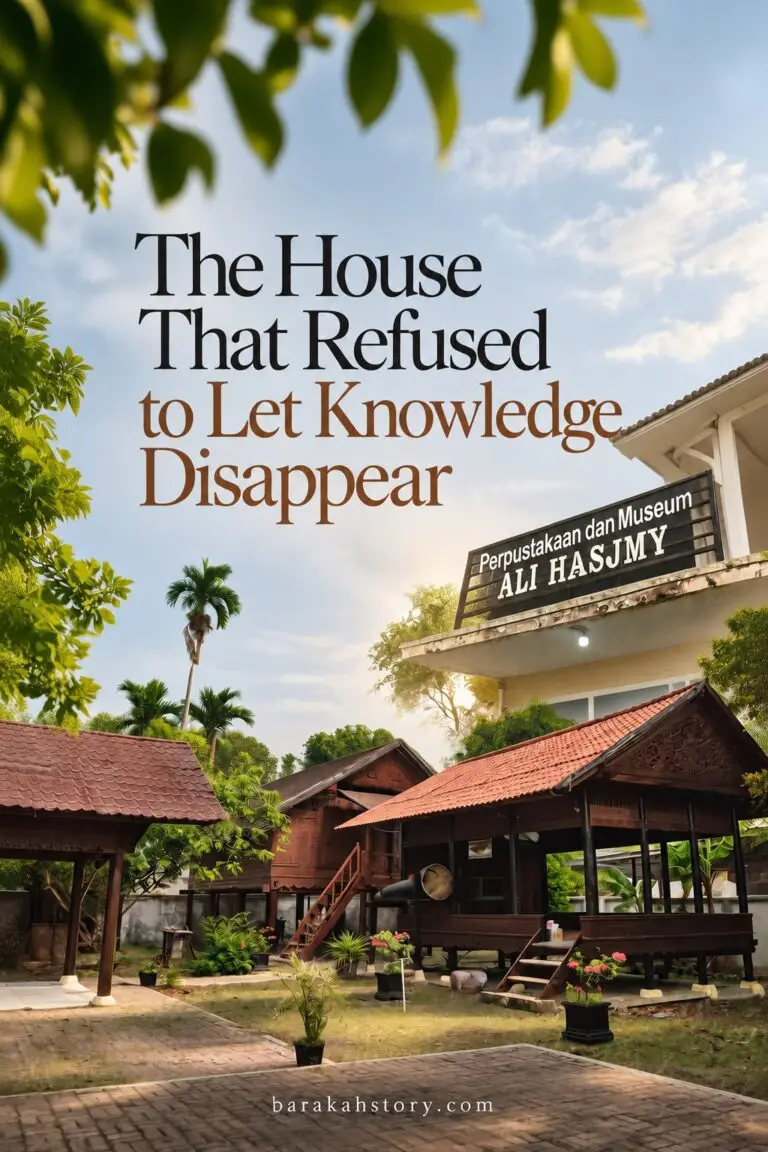
It is a beautiful, peaceful house that has now been transformed from a private residence into a library and museum.
Inside are thousands of books and various personal collections that he gathered throughout his life.
But before I began looking at the collections, one thing made me stop for quite a while.
A piece of writing.
It was Ali Hasjmy himself who had written about the fear that one day everything he had gathered might lose its place.
“When I reached old age, the books, documents, and cultural objects that I had painstakingly collected for decades began to make me anxious…”
He imagined what would happen to everything after he was gone.
Would they be sold like scrap?
Would these objects eventually become nothing more than wrapping paper for merchandise?
I stood there quietly after reading it.
Because the concern felt deeply human.
Someone spends decades gathering knowledge, books, documents, and cultural objects.
Then, as his years grow older, one question begins to emerge:
After I am gone, who will take care of all of this?
And as I entered the rooms of the house, I began to understand why that concern had been so great.
The collection was not only about literature.
There were books on religion.
History.
Law.
Psychology.
Economics.
Education.
Journalism.
Novels.
Language.
There were books in Indonesian, Malay, Arabic, and English.
I even found several titles I had never seen before.
One of them was China and India: Strategies for Global Business by Pete Engardio.
There was also The Elements of Editing: A Modern Guide for Editors and Journalists by Arthur Plotnik.
And the longer I looked at those shelves, the more I began to feel that Ali Hasjmy’s love for books was more than simply a love of reading.
He was building a world of knowledge around him.
And that world turned out to be much larger than Aceh.
Ali Hasjmy: A Life Built Across Many Worlds of Knowledge
Ali Hasjmy began writing at a young age.
The Language Agency records that he was known in the literary world as a Pujangga Baru poet, with works such as Menyesal, and throughout his life he wrote across many fields. He was also active in journalism, education, history, da’wah, and government.
His path did not stop with writing.
He became involved in Islamic youth organizations from the early 1930s, helped establish youth organizations in Aceh, participated in the independence movement, and later entered the world of journalism.
During the Japanese occupation, he worked as a journalist and later became the editor-in-chief of Atjeh Shimbun.
After Indonesia gained independence, he and several colleagues established Semangat Merdeka, which was recorded as one of the newspapers directly managed by Acehnese journalists during the early years of independence.
From there, his path continued to expand.
He entered public service.
He became Governor of Aceh from 1957 to 1964.
He became an academic.
He served as Dean of the Faculty of Da’wah and Publicity.
Later, he became Rector of IAIN Ar-Raniry.
One of his important contributions to education was his role in developing the Faculty of Da’wah at IAIN Ar-Raniry, which academic research describes as the first faculty of da’wah in Indonesia.
So when I stood inside his house and looked at thousands of books, I no longer saw them simply as the collection of a man who loved books.
I began to see Ali Hasjmy through the life those books represented – a human being who spent his years moving from one space of contribution to another.
Writing.
Journalism.
Education.
Da’wah.
History.
Public service.
And interestingly, his influence did not stop in Aceh.
A study from Universiti Pendidikan Sultan Idris in Malaysia specifically discusses Ali Hasjmy as an Acehnese Malay and a figure within the wider Malay world.
His intellectual presence was therefore not limited to Aceh.
His writings circulated beyond Indonesia.
His works appeared in various publications in Indonesia, Singapore, and Malaya, and some of his books were also published in Singapore.
One study of his legacy even notes that his influence and recognition extended into Malay countries across Southeast Asia.
At that point, I began to see something differently.
A person can begin in one place and still become part of a much larger intellectual landscape.
Aceh was where he grew.
But his thoughts did not stop at Aceh’s borders.
His writings travelled.
His books travelled.
His ideas travelled.
And his readers travelled across borders with them.
When the House of Ali Hasjmy Becomes a Legacy
Yet there was a small irony that brought me back to the words I had read on the wall.
The house that is now a library and museum has begun to lose some of its visitors since the pandemic.
And when visitors decline, maintaining a private institution like this naturally becomes its own challenge.
A library and museum established through a family foundation does not stand in the same position as a state institution with public funding mechanisms.
I then remembered what I had seen at Kerkhof.
A historical site can face a similar challenge when generations change and people’s attention toward the past changes with them.
The building remains.
The collections remain.
The history happened.
But its continuation still depends on people who are willing to care.
And that is where Ali Hasjmy’s concern from decades ago finds its answer.
He was afraid that his collections would lose their place after he was gone.
His family eventually transformed the house into a library and museum.
They did not allow the books to remain the possession of one family alone.
They created a space where that knowledge could be passed on.
But keeping a place alive requires more than simply opening its doors.
It needs people who come.
People who read.
People who ask questions.
People who tell the stories again.
And people who believe that what previous generations built still has meaning for life today.
What Ali Hasjmy Leaves Us to Carry Forward
I began to think:
Maybe legacy never truly ends when someone dies.
It changes hands.
From the person who built it,
to the person who receives it.
Then to the next person.
And every generation has to decide:
Will we let it disappear,
or will we carry it forward?
I do not know what will happen to every book in that house several decades from now.
I do not know how many people will come to visit.
But at least that day, I learned something.
A contribution does not always have to be something new.
Sometimes, our contribution is simply protecting something someone else has already built so that it does not disappear.
And this story is one small way for me to take part in that.
Not because I can save a museum.
Nor because one piece of writing will change everything.
But because Ali Hasjmy once lived and worked in this city, and left something behind.
And when we encounter it,
we have a choice.
We can walk past it.
Or we can stop for a moment,
look,
read,
and help someone else see it too.
In its own time, everything eventually comes to an end.
A house.
A book.
A name.
Even a human life.
Our task is not to control how everything will end.
Our task is to fulfil the part Allah has entrusted to us.
Then leave the outcome to Him.
Alhamdulillah.
For a house that was once a home.
Then became a library.
Then became a museum.
And today, once again, reminded me:
What we preserve today
may become someone else’s beginning tomorrow.