An Islamic reflection on leaving a legacy, preserving stories,
and the quiet question a village monument continues to ask.
Bismillah…
A Monument at the Entrance of My Village
Morning walks have introduced me to many people.
An old couple.
Two women I no longer meet.
An elderly woman whose answer stayed with me for more than twenty years.
But morning walks have also introduced me to something else.
A monument.
Every time I arrive at the entrance of my village, my eyes return to the same sight.
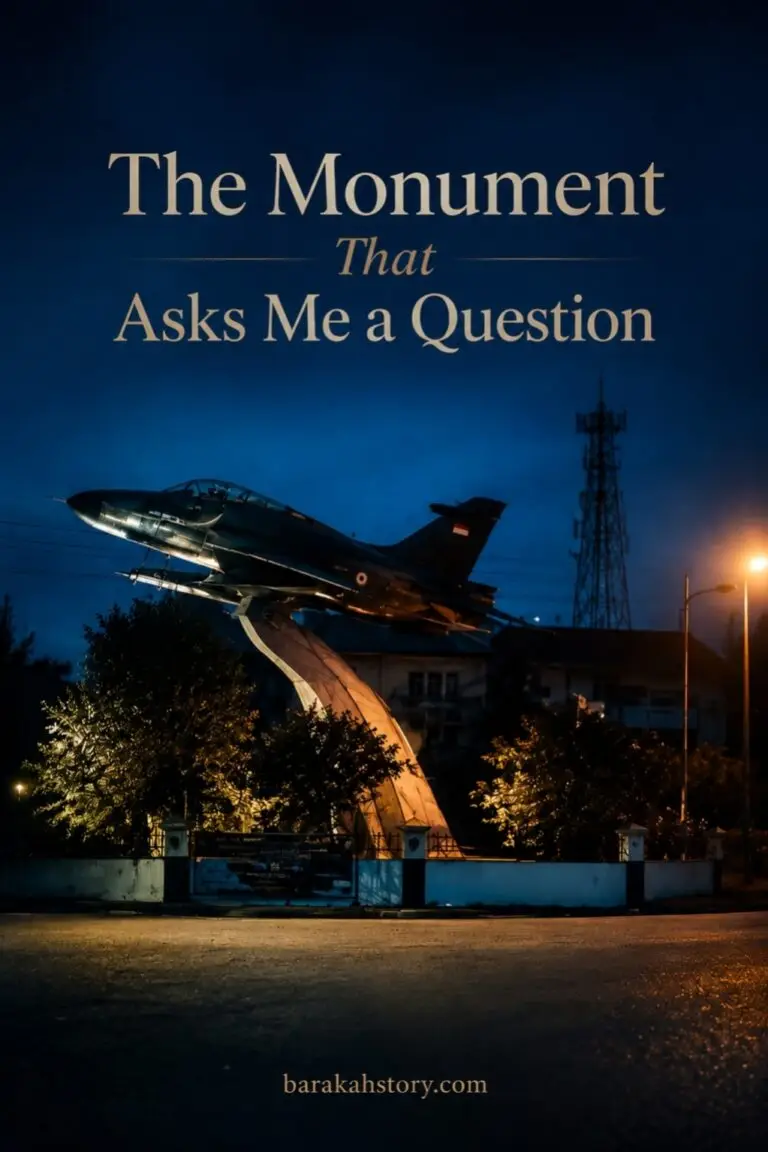
A fighter jet monument standing quietly beneath the morning sky.
A fighter jet monument is not something people expect to see at the entrance of a village.
Yet that is exactly what marks mine.
People do not always mention the village by its official name anymore.
Instead, they simply say,
“The village with the fighter jet.”
And everyone knows exactly where they mean.
My village is about thirty-five minutes from the city and
twenty minutes from Sultan Iskandar Muda Airport.
Yet rice fields still stretch across the landscape.
Mountains remain visible in the distance.
Rivers are never too far away.
Nor is the sea.
Fresh morning air still moves freely here.
A gift many crowded cities can no longer offer.
And every time I pass this monument, I cannot help but smile.
Because part of me still entertains a childlike thought.
What if this monument were not merely a monument?
What if it could suddenly come alive, spread its wings, and carry me across continents?
No airports.
No visas.
No long queues.
Just a fighter jet taking me around the world.
It is a simple imagination.
Yet it reminds me that morning walks are not merely about physical movement.
They are also spaces where imagination continues to live.
Where dreams still have room to breathe.
The Story Behind the Monument
Eventually, curiosity led me to ask why this monument exists.
And I learned something beautiful.
Indonesia’s first Air Force pilot came from this village.
Decades have passed.
His body has long returned to Allah.
His name may only be remembered by those who study history.
Yet the monument remains.
Standing quietly.
Refusing to let memory disappear.
Standing there morning after morning, the monument does something unexpected.
It quietly interrupts ordinary routines.
Motorcycles pass.
Students leave for university.
Farmers begin another day in the rice fields.
People head toward the city to work.
Some notice it.
Many no longer do.
Familiarity has a way of making remarkable things appear ordinary.
Yet the monument never seems concerned about being noticed.
It simply continues standing where it has always stood.
Patient.
Steady.
Almost as if it understands that remembrance does not always begin with attention.
Sometimes it begins with presence.
Over time, I realized that every community carries memories beyond the people currently living in it.
We often think history belongs inside museums, archives, or documentaries.
Yet history also lives beside the roads we travel every day.
It stands quietly in places we pass without slowing down.
A village remembers.
A river remembers.
A mosque remembers.
Even a silent monument remembers.
Places become witnesses.
Long after conversations have faded and generations have changed,
they continue preserving traces of those who came before us.
The monument does not speak with words.
Yet every morning, it seems to ask anyone willing to pause,
“Who came before you?”
“What did they leave behind?”
“And what will remain after your footsteps are gone?”
Reminding every passerby that once,
there was a child from this village who grew up and contributed to something much bigger than himself.
Not only for his nation.
But also for the place he once called home.
Leaving a Legacy Begins with a Question
Over time, I realized this monument keeps asking me the same question.
Leaving a legacy begins with a question, and this monument never lets me avoid it.
A question I cannot easily answer.
If tomorrow you were gone,
what would remain?
It is a difficult question.
One that follows me long after I leave the monument behind.
Because answering it feels like assembling a puzzle Allah has already designed piece by piece.
Some parts are already visible.
Others are still hidden.
Yet little by little, I am beginning to recognize something that could one day become an inheritance.
Not merely achievements.
Not merely milestones.
But patterns.
Patterns of resilience.
Patterns of faith.
Patterns of loss.
Patterns of rebuilding.
Patterns that future generations may encounter again in different forms.
The Patterns We Pass Forward
Historians study civilizations because they understand that patterns often repeat.
Looking backward helps them understand what may come next.
Our own stories carry patterns too.
Patterns worth preserving.
Patterns worth understanding.
Patterns that may help those who come after us navigate life with greater awareness.
Some patterns deserve to continue.
Others quietly ask to end with us.
As I reflected on this, another realization slowly unfolded.
Every generation receives an inheritance.
Some inherit wisdom.
Others inherit fear.
Some receive courage because someone before them chose faith over despair.
Others spend years healing wounds they never personally created.
Families often pass down more than names, homes, or possessions.
They also pass down ways of thinking.
Ways of speaking.
Ways of responding to disappointment.
Ways of treating one another.
Ways of trusting Allah during seasons of uncertainty.
Many of these patterns become so familiar that we mistake them for permanence.
Only reflection allows us to step back and
ask whether they still deserve a place in the generations that follow.
Not every inheritance should simply be preserved.
Some need to be restored.
Some need to be transformed.
And some, by Allah’s mercy, should end with us.
Breaking unhealthy patterns is also part of leaving a legacy.
Sometimes the greatest inheritance we leave is not something we pass on,
but something we choose to end.
Children may never know the burdens that stopped with their parents.
Grandchildren may never realize the sacrifices that quietly protected them.
Yet the fruits remain.
In that sense, legacy is shaped not only by what we choose to pass forward.
It is also shaped by what we lovingly refuse to pass on.
That is why preserving stories matters.
Every story honestly lived can become part of leaving a legacy for those who come after us.
Not because our lives are extraordinary.
But because our lives carry traces of experiences others may one day need.
To heal.
To understand.
To continue.
To begin again.
A Legacy That Continues After Us
As Muslims, we know that our names alone are not what survive us.
Leaving a legacy, from an Islamic perspective, has never been about preserving our names.
It is about leaving behind deeds that continue benefiting others after we have returned to Allah.
“When a person dies, all their deeds come to an end except three: ongoing charity (ṣadaqah jāriyah),
beneficial knowledge, or a righteous child who prays for them.” (Sahih Muslim 1631)
The Prophet ﷺ taught that when a person dies, their deeds come to an end except for ongoing charity,
beneficial knowledge, and a righteous child who prays for them.
That reminder has always expanded my understanding of leaving a legacy.
It reminded me that the truest legacy is not measured by recognition,
but by benefits that continue long after we have returned to Allah.
Legacy is not built through recognition alone.
It is nurtured through lives that continue benefiting others after we have returned to Allah.
Sometimes that benefit comes through teaching.
Sometimes through kindness that shaped another heart.
Sometimes through words preserved in a book.
Sometimes through values quietly practiced inside a family.
And sometimes through stories that remind someone they are not walking alone.
Every morning, the fighter jet remains exactly where it has always been.
Every time I walk past it, I am reminded that leaving a legacy is often quieter than we imagine.
Silent.
Unmoving.
Yet somehow, it continues speaking.
Not about war.
Not about aircraft.
But about contribution.
About remembrance.
About meaning.
And about the responsibility each of us carries.
To ask ourselves:
What am I building today
that might still serve someone
after I am gone?
Looking back, I have come to understand that the question itself is already part of the answer.
Leaving a legacy is not a destination we reach at the end of life.
It is a way of living that is shaped one ordinary day at a time.
Legacy is rarely built in a single moment.
The monument reminded me that leaving a legacy does not begin when people remember us.
It begins long before that, in the ordinary choices no monument will ever record.
It is shaped slowly.
Through the values we live by.
The wounds we choose to heal.
The wisdom we preserve.
And the stories we leave behind.
Because leaving a legacy is rarely about what we accumulated.
It is about what survives us.
What we nurtured.
What we repaired.
What we taught through our actions.
What we embodied.
And what we chose to pass forward.
Alhamdulillah for every place, every encounter,
and every quiet reminder that leaving a legacy begins with the ordinary moments Allah places before us.
That quietly teaches us what truly remains after we leave.