
An Islamic Reflection on Tawakkul, Rizq, and Trust in Allah
Bismillah…
Twenty years ago,
I was a university student attending a journalism training program
at an Islamic Center in a city I had never visited before.
It was my first time meeting many brothers and sisters involved in Islamic media and da’wah publications.
As part of the training, every participant received the same assignment.
Go outside.
Observe.
Find a story.
Write about it.
Nothing more.
Trusting Allah for Rizq Begins with Unexpected Encounters
No companion.
No local guide.
Only a map.
As a stranger in a city I barely knew, I decided to explore it on foot.
It felt safer than taking public transportation and risking getting lost.
Besides, walking allowed me to observe people more closely.
To notice details.
To pay attention.
To slow down enough for stories to reveal themselves.
At least, that was what I thought I was doing.
I thought I was looking for news.
I did not know I was about to receive a lesson that would remain with me for the next twenty years.
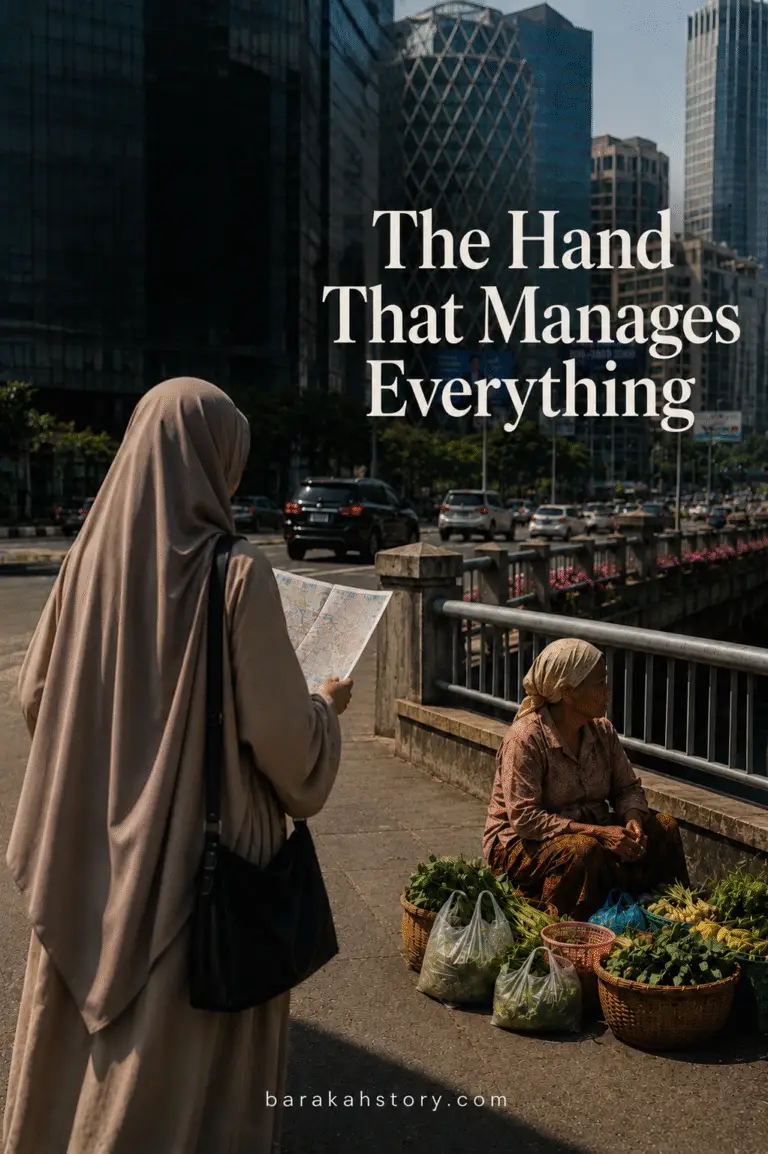
As I walked through unfamiliar streets, my eyes stopped at an elderly woman.
She was sitting beside a bridge.
Selling vegetables.
Under the hot sun.
At an age when many people would have chosen to rest, she was still there.
Working.
Smiling.
Waiting for customers.
Something about her drew me in.
Looking back, I have come to believe Allah wanted me to hear what she was about to say.
Tawakkul in Islam Is Often Learned Through Everyday Life
I greeted her and introduced myself.
As part of our assignment, we had been given reporting cards,
so I showed her mine as a way of introducing myself.
She smiled.
At first, I thought I was simply completing a task.
Finding a story.
Gathering information.
I did not know I was about to receive a lesson I would carry for the next twenty years.
I asked what she was selling.
She smiled.
“Vegetables, dear.”
“It’s what I do every day.”
I asked if she had children.
She smiled again.
“Yes.”
“Do they send you money?” I asked.
She shook her head gently.
“I don’t want to burden them.”
“Do they know you are still working?”
“Yes.”
“But I don’t like becoming a burden to anyone.”
There was no sadness in her voice.
No resentment.
No disappointment.
Only acceptance.
And gratitude.
I asked another question.
“How much do you earn in a day?”
“Thirty to fifty thousand rupiah.”
I remember wondering how someone could survive on such a small amount.
How did she buy food?
How did she pay for her needs?
How did she continue smiling?
I was young at the time.
Still trying to understand life.
Still believing that security depended heavily on what we could calculate.
What we could save.
What we could predict.
Then she asked me a question.
A question I never expected.
“Dear,” she said softly.
“What does a lizard eat?”
“Mosquitoes,” I answered.
She nodded.
Then she asked another question.
“Can a lizard fly?”
“No.”
“It cannot.”
She smiled again.
Then she asked:
“If a lizard cannot fly, how can it eat a mosquito that flies?”
I became silent.
Because I had never thought about it before.
She looked at me kindly.
Then she answered her own question.
“There is a Hand that manages everything.”
“As long as we work, remain honest, and stay patient, Allah will not leave us.”
“The lizard always finds its food.”
“And Allah always takes care of His creation.”
Then she said something that has stayed with me ever since.
“I never resent my children.”
“I still pray for their happiness.”
“Allah has been good to me.”
Those words surprised me.
Because many people in similar situations would have focused on what they lacked.
On what they wished their children had done.
On what life had not given them.
Yet she focused on what remained.
On what Allah had already provided.
On what she still had.
She was still able to walk.
Still able to work.
Still able to smile.
Still able to pray.
And that was enough for her heart to remain at peace.
That day, I found more than a story.
I found a reminder.
A reminder that has followed me through many seasons of life.
Looking back, I now see that this encounter became my first lesson in trusting Allah for rizq.
It would take me years to realize that her simple words echoed
what Allah had already promised in the Qur’an:
“…And whoever puts their trust in Allah, then He is sufficient for them.
Surely Allah achieves His purpose. Allah has already set a destiny for everything.”
(Qur’an 65:3)
Trusting Allah for Rizq Through Every Season of Life
Life has taken me through moments of certainty and moments of uncertainty.
Some seasons felt easy.
Others felt heavy.
There were periods when I worked hard toward goals I deeply wanted.
Learning new skills.
Improving myself.
Trying different paths.
Building things.
Starting over.
Beginning again.
Some efforts bore fruit.
Others did not.
Some doors opened.
Others remained closed.
Some plans unfolded beautifully.
Others disappeared before they had the chance to grow.
And during those seasons, I often found myself remembering that elderly woman beside the bridge.
She reminded me that trusting Allah for rizq begins when the doors we expect remain closed.
Sometimes Allah opens a path we never planned for.
Sometimes provision comes through people we never imagined meeting.
Sometimes opportunities appear in places we never considered.
And sometimes what we thought was a delay was simply Allah redirecting us toward something better.
Only years later did I realize that the simple wisdom of an elderly vegetable seller
echoed a truth Allah had already revealed:
“There is no moving creature on earth whose provision is not guaranteed by Allah. And He knows where it lives and where it is laid to rest. All is written in a perfect Record.” (Qur’an 11:6)
The older I become, the more I realize that one of life’s greatest wisdoms
is learning where our responsibility ends and where tawakkul begins.
Effort and Tawakkul Always Walk Together
Because effort and control are not the same thing.
Many of us spend our lives trying to secure our provision
instead of learning the quiet discipline of trusting Allah for rizq.
We study.
We work.
We plan.
And we should.
Because effort is part of our responsibility.
Islam never teaches passivity.
Islam teaches action.
Preparation.
Excellence.
Discipline.
Persistence.
But effort has never been the same thing as control.
A farmer plants.
Yet only Allah sends the rain.
A merchant sells.
Yet only Allah opens hearts to buy.
A bird leaves its nest.
Yet only Allah knows where its provision awaits.
Rizq was never something we controlled.
It was always something we pursued while trusting Allah.
In time, I came to understand that trusting Allah for rizq is not the absence of effort,
but the surrender of outcomes to the One who provides.
Allah’s Provision Is Beyond Our Control
That is why tawakkul is not laziness.
It is not giving up.
It is not waiting for life to happen without effort.
Tusting Allah for rizq begins with working.
Striving.
Showing up.
Doing our best.
And then accepting that the outcome belongs to Allah.
Because provision does not come from effort alone.
It comes by Allah’s permission.
That is when peace enters the heart.
When we stop acting as if we control everything.
When we stop carrying burdens Allah never asked us to carry.
When we stop measuring our worth solely by results.
When we stop believing that every unanswered prayer is rejection.
Sometimes Allah answers through abundance.
Sometimes He answers through delay.
Sometimes He answers through redirection.
And sometimes He answers by teaching us to trust Him more deeply.
Every one of those seasons became another invitation to keep trusting Allah for rizq,
even when I could not yet see how His provision would unfold.
The Hand That Manages Everything
Twenty years have passed since that journalism training.
I do not remember every lesson taught in that classroom.
I do not remember every speaker.
I do not remember every assignment.
But I still remember an elderly woman sitting beneath the sun.
Selling vegetables.
Smiling.
And sharing a way of seeing life that stayed with me for decades.
That behind every closed door.
Behind every uncertainty.
Behind every season of waiting.
Behind every unanswered question.
There is a Hand that manages everything.
The Hand of Allah.
Alhamdulillah for every effort.
For every provision.
For what arrived.
For what did not.
And for everything in between.