
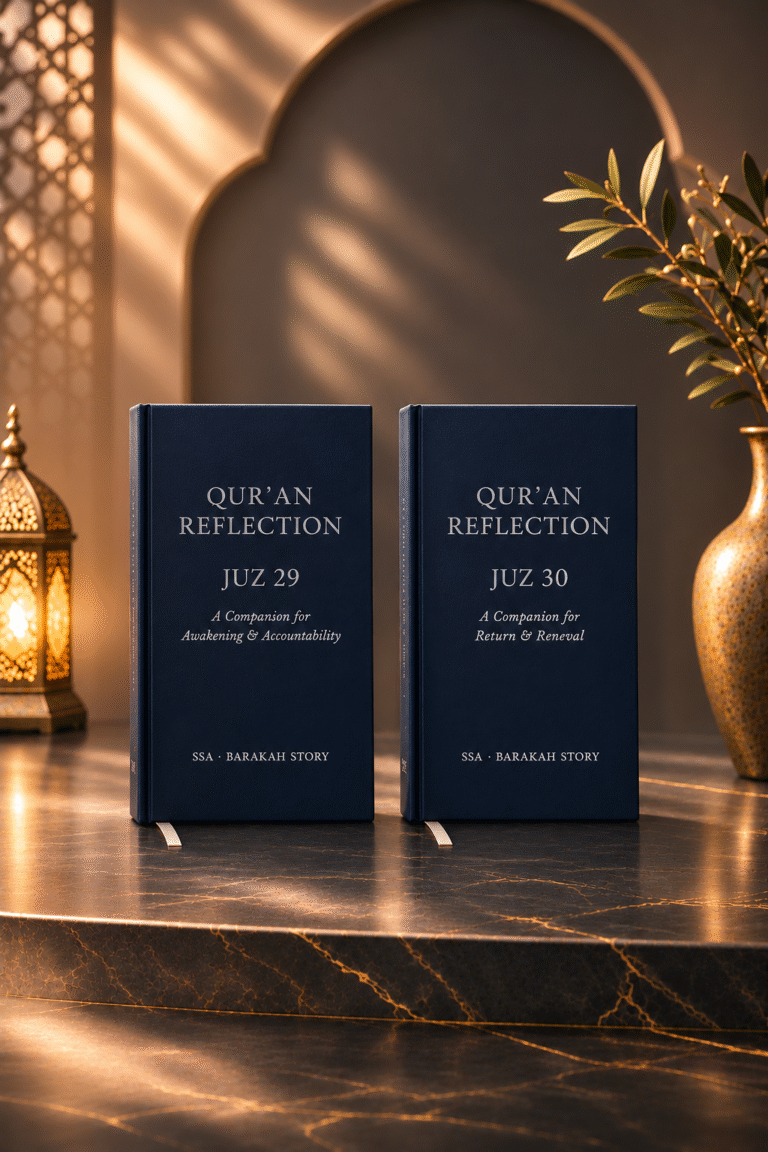
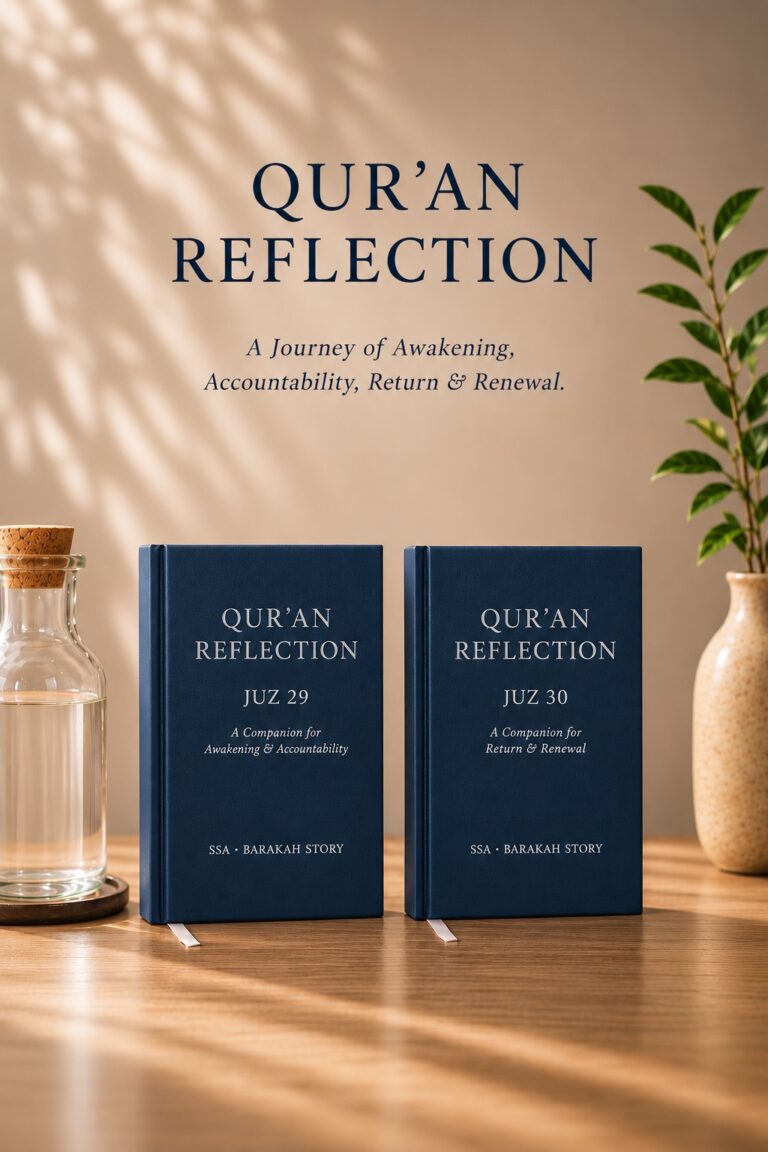
QUR'AN REFLECTION JUZ 29 & JUZ 30
Two Companions. One Deeper Relationship with the Qur’an.
بِسْمِ اللّٰهِ الرَّحْمٰنِ الرَّحِيْمِ
Bismillah…
Return to the words that have always been there.
Awaken
to the life you are already living.
Alhamdulillah...
with the permission of Allah,this book was born from a longing.
A longing to pause before moving forward.
To look again at the person, we are becoming.
Not only at what we believe, but at what shapes us.
Not only at what we do,
but at what happens within us
when life becomes difficult,
when we are given,
when we are denied,
when we are praised,
when we are tested,
and when we are asked
to carry something greater than ourselves.
Because the Qur’an does not only speak about
the destination
of human beings.
It also reveals the patterns that take us there.
The convictions we hold.
The character we develop.
The choices we make.
The responsibilities we carry.
Not simply to read more verses,
but to understand what Allah has revealed
and recognize how its guidance meets the life we are living.
A quiet awakening to something that has always been nearby.
When the Qur’an Becomes Part of How We Live
There are questions we carry throughout our lives.
Some arise when we are trying to understand ourselves.
Others appear when relationships become difficult,
responsibilities grow heavier,
or life takes a direction we never imagined.
We ask ourselves:
How do we remain patient when life does not go as planned?
How do we make decisions when the right path is not immediately clear?
How do we raise our children with wisdom?
How do we handle success without becoming attached to what we possess?
How do we remain grateful when life is generous, and steadfast when it is not?
And beneath many of these questions lies something deeper:
How do we live this life in a way that remains pleasing to the One who created us?
We spend years learning how to navigate the world.
Building careers. Managing responsibilities.
Understanding people. Protecting what matters.
Preparing for the future.
Yet one of the most important relationships in our lives
is not always given the attention it deserves.
Our relationship with the Qur’an.
The Qur'an Has Always Been Speaking to Us
The Qur’an is not distant from the realities of human life.
It speaks about the human heart, the nature of this world,
the weight of our choices, the relationships we build,
and the responsibilities we carry.
It speaks about gratitude and arrogance.
Patience and impatience.
Wealth and generosity.
Family, trust, justice, and human weakness.
It tells us about those who remained steadfast
when everything around them seemed to oppose the truth.
It shows us what happens
when people become consumed
by what they possess, forget their Creator,
or allow pride to stand between themselves and guidance.
And it reminds us of something we can easily overlook:
Life is not simply something to experience.
It is something entrusted to us.
Every day,
through the way we think, speak, choose, and respond,
we are shaping the person we are becoming.
The world changes.
Human circumstances change.
But our need for guidance does not.
The Qur’an has always addressed
the realities of the human condition.
Its guidance remains relevant
not because every generation
lives through identical circumstances,
but because human beings continue to encounter
questions of faith, character, desire, responsibility, and return.
Reading is Where We Begin.
Understanding is Where We Go Deeper.
Many of us have grown up hearing and reciting the Qur’an.
We know familiar surahs.
We recognize their sounds.
We return to certain verses in our prayers,
during difficult seasons,
and in moments when we need reassurance.
Yet familiarity with the words
does not always mean
familiarity with their meanings.
We can recite a verse without fully understanding
what it asks us to recognize.
We can speak about patience while struggling
to recognize impatience within ourselves.
We can seek guidance while holding on to assumptions
that prevent us from seeing clearly.
This is where reflection becomes important.
Not because our personal thoughts
can replace the meaning of
revelation.
But because understanding the Qur’an asks us
to become attentive to what Allah has revealed.
To read with care.
To learn its context.
To understand its message
through sound knowledge and tafsir.
And then,
to look honestly at the distance between
what we have understood and how we actually live.
Reflection is not about making the Qur’an fit our lives.
It is about allowing the guidance of the Qur’an
to help us see our lives more truthfully.
That distinction matters.
The Qur’an remains the source of guidance.
Tafsir helps us approach its meanings with knowledge and care.
Reflection gives us room to
examine ourselves in light of what we have learned.
When Understanding Begin to Change The Way We Live
Consider an ordinary day.
The expectations that are not met.
The things we wish we had.
The decisions no one else sees.
The people closest to us.
When we understand patience,
we begin to examine how we respond
when life does not unfold as we hoped.
When we understand gratitude,
we begin to notice how easily
our attention moves towards what is missing,
while overlooking what Allah has
already entrusted to us.
When we understand accountability,
even our private
decisions begin to carry a different weight.
And when we understand that this life is a journey
towards our return to Allah,
ordinary choices begin to acquire a deeper significance.
The Qur’an does not promise a life free from difficulty.
It gives us guidance for meeting life with faith,
knowledge, wisdom, and responsibility.
Sometimes,
the greatest change does not begin
with a change in our circumstances.
It begins when we see those circumstances differently.
When we recognize our own responses.
And when we understand what is being asked of us.
A familiar verse can open a new question.
A question can lead us back to knowledge.
And understanding, when received with sincerity,
can gradually shape the way we live.
Two Juz. Two Movements. One Journey with The Qur'an
Juz 29 and Juz 30 begin near the end of the Qur’an,
yet they
open two distinct and complementary journeys.
They are not simply two portions of the Qur’an
brought
together in one collection.
Each has its own character.
Each brings different dimensions
of the human journey into view.
Juz 30 brings us close to the words we often recite.
Juz 29 invites us to look more deeply at the human being who reads them.
One draws our attention towards return and renewal.
The other awakens us to character, responsibility, and accountability.
Together, they invite us to consider not only what we
believe,
but how that belief shapes the life we are living.
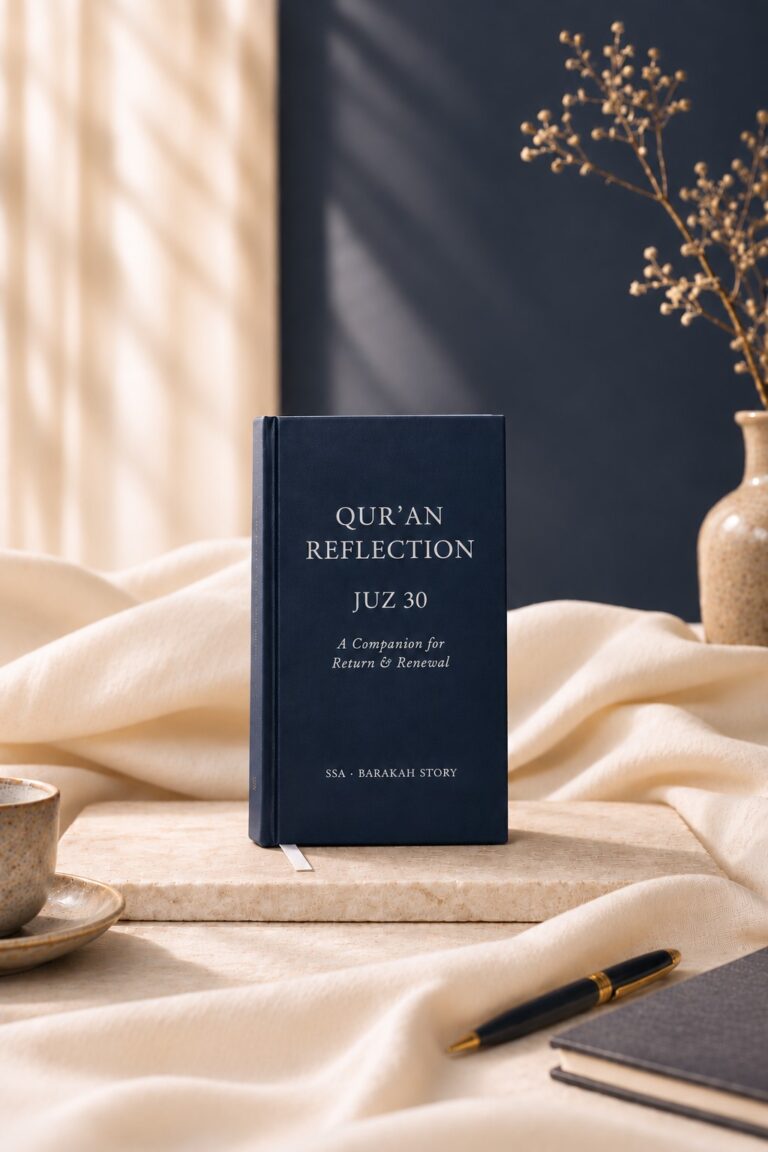
JUZ 30 - Return & Renewal
Where the Qur’an already walks with daily life.
Juz 30 lives close to our days.
Its surahs accompany our prayers.
Their words are present in our fears, our hopes,
our questions, and even our exhaustion.
Often, we recite them without realizing how deeply
they
speak to the states of the human heart.
In Ad-Duha,
we encounter reassurance and the reminder
of Allah’s care and favour.
In Al-Inshirah,
we are reminded of the relationship between hardship and ease,
and the importance of turning towards Allah.
In Al-Asr,
we are brought face to face with the value of time
and the qualities that distinguish those who are not in loss:
faith, righteous deeds, truth, and patience.
In Al-Ma’un,
the relationship between worship and our
treatment of others comes into view.
The care of those in need is not separate
from the sincerity of our faith.
In Al-Ikhlas,
we encounter the clarity of tawhid:
the
absolute oneness of Allah, as He has revealed Himself.
And in Al-Falaq and An-Nas,
we learn to seek
refuge in Allah from the harms that are visible
and those that remain hidden.
These are only some of the encounters within Juz 30.
When its surahs are approached together,
a wider movement
begins to emerge.
A movement of awakening.
Of struggle.
Of hope.
Of courage.
Of clarity.
Of Divine mercy.
Of the human heart recognizing its dependence upon Allah
and learning to return to Him.
Its surahs remind us of the protection we seek from Him,
the certainty of our faith,
the importance of the time entrusted to us,
and the reality of the Hereafter.
Juz 30 helps us recognize that the Qur’an is not meant
to remain within the prayer mat or the moments when we seek reassurance.
Its guidance belongs to the ordinary life we return to after prayer.
A companion for returning, remembering,
and renewing our
relationship with Allah.
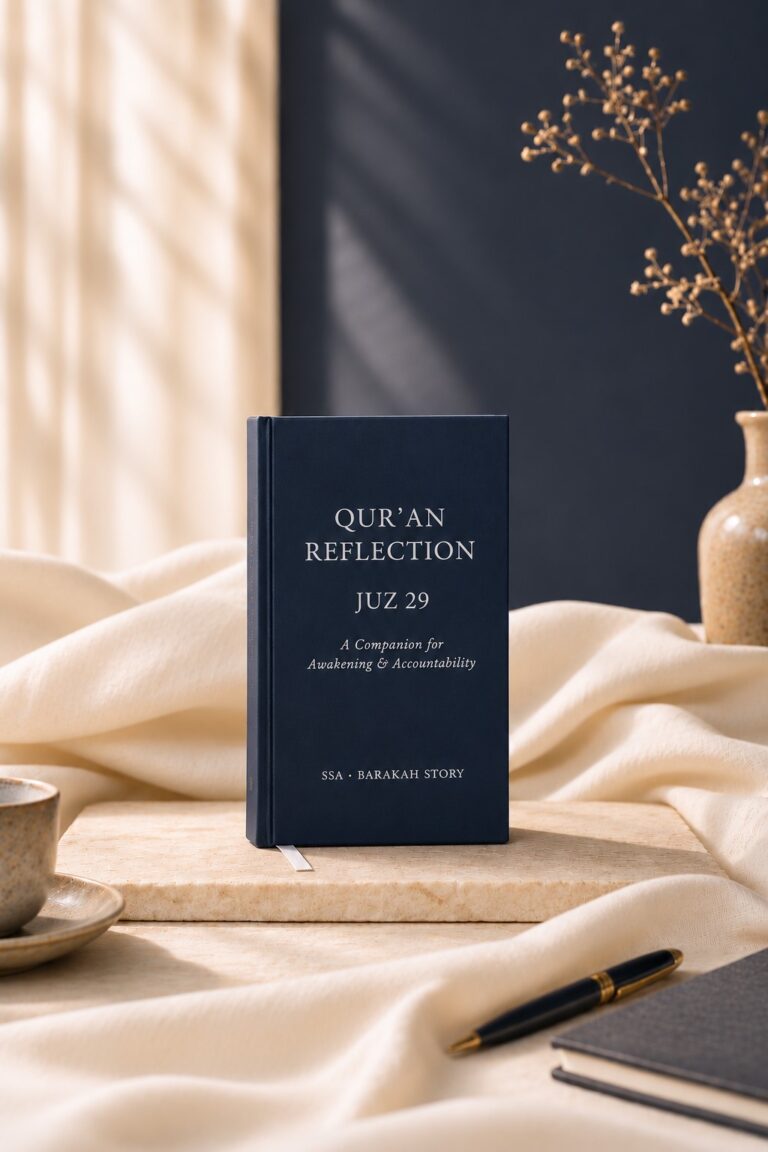
JUZ 29 - Awakening & Accountability
When we begin to see the human being,
and the life we are responsible for.
Juz 29 begins with a question of ownership.
In Al-Mulk,
we encounter the recognition that all
dominion belongs to Allah.
And beneath that recognition lies another question:
What are we doing with the life we have been given?
From there,
Juz 29 moves through some of the deepest
landscapes of the human being.
Pride. Wealth. Denial. Restlessness.
Patience. Rejection. Perseverance.
Preparation. Responsibility. Choice.
Death. And accountability.
In Al-Qalam,
we encounter character under the
influence of wealth, status, and pride,
and the danger of forgetting the source
of our blessings.
In Al-Haqqah,
the certainty of the Last Day comes into view.
The reality of the final account
is no longer something distant from the life we live.
In Al-Ma’arij,
we encounter the restless nature of the human being under pressure,
alongside the qualities of those whose prayer
and devotion shape a different response.
Through the story of Nuh,
we witness perseverance through a long and difficult calling,
even when rejection continues.
In Al-Jinn,
we are reminded that creation extends beyond
what human beings can see,
and that the Qur’an is guidance
whose message reaches beyond our assumptions.
Then come Al-Muzzammil and Al-Muddaththir.
In Al-Muzzammil,
we see the discipline of standing
before Allah in the night, the recitation,
and the preparation of the inner self
before carrying a weighty responsibility.
In Al-Muddaththir,
the call becomes unmistakable:
Rise.
A call to glorify Allah, purify oneself,
and remain patient
in carrying the responsibility entrusted by Him.
In Al-Qiyamah,
we are brought before the certainty of resurrection
and the human being who can no longer turn away
from the reality of accountability.
In Al-Insan,
we are reminded of our origin, our test,
our capacity to respond with gratitude or ingratitude,
and the significance of the choices we make.
Then comes Al-Mursalat,
with its repeated warnings
and reminders of the certainty of the Day of Consequence.
Across these eleven surahs,
we begin to recognize patterns
that appear throughout human life.
A person who becomes convinced that
what they possess
belongs entirely to them.
A heart that becomes restless when hardship arrives.
A person who hears the truth but refuses to let it change them.
A servant who continues calling towards the truth
even when
no one seems to listen.
A human being who must first be prepared inwardly
before being asked to carry something outwardly.
And eventually, a human being standing before
what they have done with their life.
Juz 29 does not simply tell us what will happen at the end.
It lets us look at the road that leads there.
The character we form.
The convictions we hold.
The responsibilities we carry.
And the choices that shape our return.
Its movement is one of awakening.
From seeing, to recognizing.
From being formed, to carrying responsibility.
And ultimately, to accountability.
A companion for seeing more clearly, taking responsibility,
and living with an awakened awareness of our return to Allah.
Two Complementary Movement
Juz 29 and Juz 30 do not offer identical journeys.
Juz 30 brings us towards the foundations of faith,
the nearness of Allah,
the struggles of the heart,
the protection of our faith,
and the renewal of our relationship with our Creator.
Juz 29 invites us to examine human character,
recognize the weight of responsibility,
understand the consequences of our choices,
andbecome more conscious of the life entrusted to us.
One helps us return.
The other asks us to awaken.
Together, they bring two essential questions into our daily lives:
Am I staying close to the One who created me?
And am I living this life in a way
that reflects the guidance I have received?
These questions belong together.
Because a relationship with the Qur’an
is not measured only by how much we read,
but also by how its guidance gradually shapes the way we live.
More Than Reading: Understanding and Memorization
Many of the surahs in Juz 30 accompany our daily prayers.
Their familiarity makes them especially meaningful torevisit,
understand, and gradually commit more deeply to memory.
Juz 29 offers another field of engagement:
longer surahs whose messages unfold through stories,
reminders, descriptions of human nature,
and the realities of accountability.
Approaching both portions with understanding
gives memorization a deeper context.
We begin to recognize not only the words we are learning,
but also the meanings we want to remember.
The purpose is not to turn the Qur’an
into another target to complete.
It is to build a relationship in which recitation,
understanding, reflection,
and practice gradually strengthen one another.
For those beginning to memorize,
these two Juz offer
meaningful portions to study and revisit.
For those who have already memorized them,
they offer an opportunity to return
to familiar verses with renewed understanding.
And for those who are still finding their way
towards a deeper relationship with the Qur’an,
they offer a thoughtful place to begin.
What Makes Qur'an Reflection Different
Each book is designed as a contemplative companion,
bringing together the Qur’anic text,
classical tafsir, reflection, and personal engagement.
Rather than offering translation alone or leaving readers
to approach the meaning without context,
each surah is approached through several connected layers.
Inside each book, you will find:
The Arabic Qur’anic text and English rendering.
A clear overview of each surah and its central themes.
A reflective summary rooted in Tafsir Ibn Kathir.
Deeper insights that bring attention to the messages
and human realities within the surah.
Three layers of contemplative prompts.
Questions that invite readers to examine
their understanding and lived experience.
A dedicated du’a for each surah.
Generous space for personal writing, journaling, and stillness.
The approach is intentional.
The Qur’an remains the source of guidance.
The classical tafsir provides a foundation for understanding its message.
The reflections and prompts then create room for readers
to examine themselves in light of what they have learned.
It does not replace scholarly tafsir or invite us
to impose personal meanings upon revelation.
Instead, it encourages us to read carefully, understand
responsibly,
reflect honestly, and consider what we carry into daily life.
There is room to write.
And room to remain silent.
Both are welcome.
The books are also intentionally free from QR codes,
digital links, and scanning requirements.
No detours back to the noise of a screen.
Just the Qur’an, the page,
and the space to give its words our attention.
A Companion To Return To, Beyond The Page
Qur’an Reflection is not a book to finish in a hurry.
It is a book to revisit when life gives us new experiences,
new responsibilities, and new reasons to listen more carefully.
A surah read today may meet us differently
when we return toit a year later.
A verse we once understood intellectually may become
something we recognize more deeply
when we encounter a particular test.
The words remain.
But the person reading them continues to move through life.
This is why the relationship does not end
when we finish reading.
It grows through repeated encounters,
through meanings revisited,
andthrough the willingness to keep learning.
The books can accompany a personal study
and memorization journey,
a more thoughtful Ramadan,
or the ordinary days that follow it.
There is no need to rush through both.
A surah read with attention can remain with us
long after the page has been turned.
Your Journey with The Qur'an Begins Here
Some of the surahs in these books
may have accompanied your prayers since childhood.
You may have recited them through seasons of fear,
gratitude, grief, or hope.
The words are familiar.
Yet there is still more tounderstand.
The Qur’an has always been near.
Its guidance has always been there.
And sometimes,
what we have been searching for
is not something entirely new.
It is a deeper understanding of the words
we have known all along.
How much of the Qur’an have I read?
That is one question.
But there is another worth carrying:
How deeply have I come to understand it,
and how is that
understanding shaping the way I live?
Two Juz.
Two complementary movements.
One continuing relationship with the words of Allah.
Juz 30 - A Companion for Return & Renewal.
Juz 29 - A Companion for Awakening & Accountability.
Come closer to the words.
Make room for understanding.
Let the journey continue.
This is the heart of Qur’an Reflection Juz 29 and Juz 30.