Turkish identity, between Ottoman memory, republican transformation, and the enduring question of faith, reveals how identity survives when a civilization changes its world.
Bismillah…
Between empire and republic, between East and West,
Turkey has spent a century asking a question that is deeper than politics:
what must remain when everything else changes?
There are cities that sit between worlds.
And then there is Istanbul.
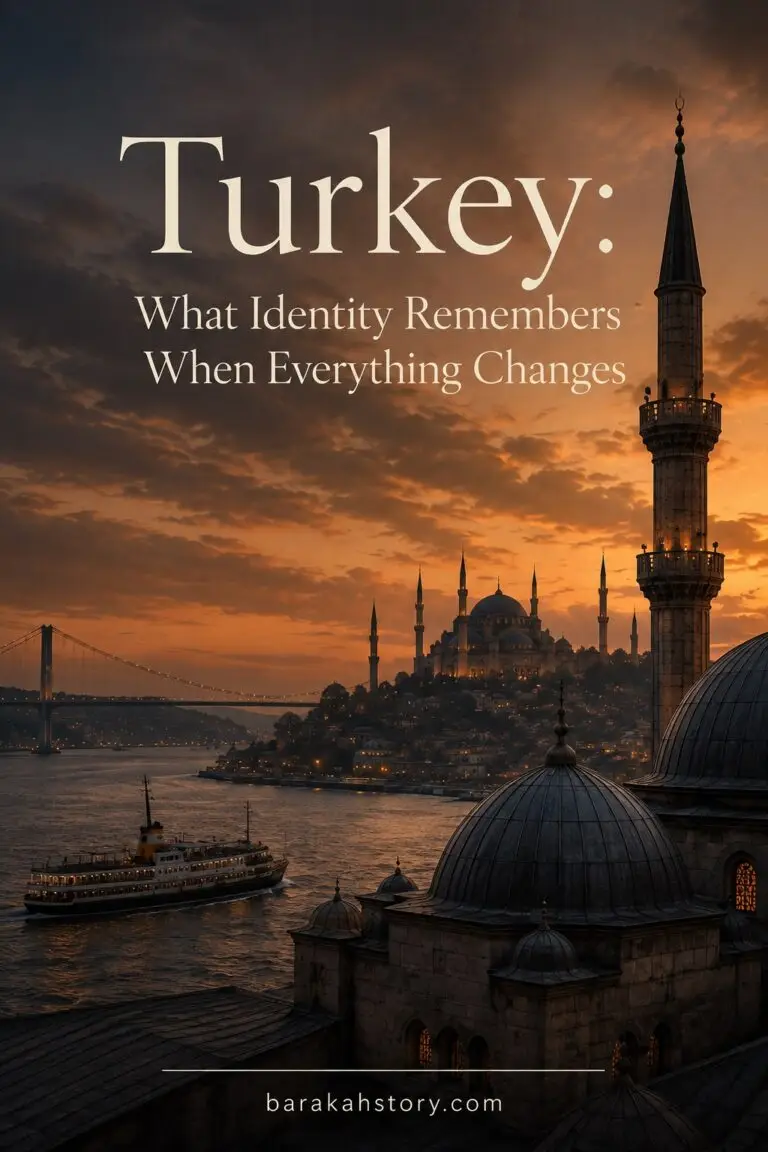
The Bosphorus divides the city between Europe and Asia,
but the deeper story of Istanbul has never been about geography alone.
It is about memory.
About what happens when a people inherit a civilization too large to forget,
yet enter a future that demands they become something different.
Istanbul has watched empires rise and disappear.
It has heard the call to prayer beneath the domes of an empire that once stretched across three continents.
It has witnessed the birth of a republic that deliberately sought a different relationship
with religion, law, language, and modernity.
And still, the city stands.
Between two continents.
Between histories.
Between identities.
That is why Turkey is not simply a story about East and West.
It is a story about what identity remembers when the world around it changes.
Turkish Identity Before the Republic: The Ottoman Empire
Long before the Turkish Republic existed, there was the Ottoman Empire.
For centuries, the Ottomans occupied a central place in the political and religious history of the Muslim world.
Its territories stretched across Anatolia, the Middle East, North Africa, the Balkans, and parts of Eastern Europe.
But the reach of the empire was never only territorial.
Its mosques, schools, courts, scholars, trade routes, architecture, and institutions became part of a civilization whose influence travelled far beyond the borders drawn on European maps.
And sometimes, that influence travelled farther than geography seemed to permit.
In the sixteenth century, the Sultanate of Aceh, facing Portuguese expansion in the Strait of Malacca,
sought assistance from the Ottoman court.
Aceh sent envoys to Istanbul.
The request was not simply diplomatic.
It was connected to a larger Muslim world whose members recognized one another across enormous distances.
Ottoman assistance eventually reached Aceh in the form of military specialists, artillery expertise, weapons,
and other support. The larger expedition envisioned by the Ottoman court was disrupted by conflict in Yemen,
but some personnel and military equipment did reach Aceh.
The relationship left traces.
One of them can still be found in Bitay, Banda Aceh, where local tradition preserves the tomb of an Ottoman figure known as Teungku di Bitay. Historical accounts connect the site with Ottoman soldiers and scholars who remained in Aceh rather than returning home.
Another memory survives in the story of Lada Sicupak, associated with the historical relationship
between Aceh and the Ottoman world.
These are not merely curiosities from an old empire.
They tell us something about identity.
Five centuries ago, two Muslim societies separated by an ocean could still recognize something familiar in one another.
The maps were different.
The languages were different.
The cultures were different.
But there was a civilization beneath them that allowed one people to see another not as entirely foreign,
but as part of a wider moral and spiritual world.
That memory matters.
Because civilizations are not held together only by borders.
They are also held together by what people believe they belong to.
Turkish Identity After the Ottoman Empire Disappeared
And then, history broke.
The Ottoman Empire did not simply lose territory.
It lost the political structure that had carried its identity for centuries.
The First World War accelerated the collapse.
The sultanate disappeared.
The caliphate disappeared.
And in 1923, the Republic of Turkey was established.
Within a few years, the transformation became profound.
The caliphate was abolished in 1924.
Religious institutions connected to the old state structure were dismantled.
The legal system was reorganized.
The Swiss Civil Code became the basis of the new civil law.
Education was centralized under a national system.
The Arabic-based Ottoman script was replaced by the Latin alphabet.
Secularism became an increasingly explicit principle of the new republic.
These were not cosmetic changes.
They touched the architecture of everyday life.
How people wrote.
How they dressed.
How courts operated.
How education was organized.
How religion related to the state.
How the nation imagined its future.
The transformation was driven by a powerful desire to build a modern, sovereign Turkish nation after the devastation and fragmentation of the Ottoman order. Turkish official historical sources describe secularization and modernization as central elements of this transformation.
And that is where Turkey becomes especially interesting.
Because history often tells us about what people gain through change.
Turkey also asks us to look at what change asks people to leave behind.
Turkish Identity, Institutions and the Memory That Remains
A nation can change its alphabet.
It can change its laws.
It can change its political system.
It can change the institutions through which it organizes society.
But changing institutions does not automatically erase memory.
A grandfather can still remember a word his grandson no longer writes.
A building can still carry the architecture of a civilization whose political order no longer exists.
A mosque can continue to stand after the empire that built it has disappeared.
A name can survive generations after the system that gave it meaning has gone.
This is the strange persistence of civilization.
History can be dismantled faster than memory.
And Turkey carries this tension visibly.
Walk through Istanbul, and layers of time appear without asking permission from one another.
Ottoman architecture.
Republican monuments.
Ancient Byzantine traces.
Modern commercial districts.
Mosques beside offices.
European fashion beside traditional dress.
The call to prayer moving through a city that is also one of the world’s great modern urban centers.
The old and the new do not always agree.
But they coexist.
And identity has always been like that.
It is not a clean room.
It is an accumulation.
We inherit more than we consciously remember.
A language.
A story.
A way of seeing family.
A relationship with faith.
A sense of beauty.
A moral instinct.
Sometimes even an absence can become part of what a generation remembers.
This is why Turkish identity becomes more complicated after a civilization experiences rupture.
The question is no longer simply:
Where did we come from?
It becomes:
What do we carry forward?
Turkish Identity and the Question Beneath Modernity
There is a question that often appears whenever a civilization encounters modernity:
What must change for us to survive?
But there is another question that is harder.
What must not change for us to remain ourselves?
Turkey’s twentieth century was deeply shaped by the first question.
How could a wounded society survive?
How could it become a modern nation?
How could it protect its sovereignty?
How could it move forward after the collapse of an empire?
Those questions were not trivial.
They were existential.
But every civilization that changes eventually encounters the second question.
What happens when adaptation becomes so deep that memory itself begins to feel inconvenient?
This is where Turkish identity becomes more than nationality.
Because identity is not merely a label.
It is an inner orientation.
It tells us what we consider worth preserving.
What we are willing to sacrifice.
What we refuse to forget.
And what we are prepared to change.
Perhaps this is why identity is rarely questioned when everything feels familiar.
It becomes clearer when everything around it begins to change.
A Bridge Does Not Become Less Itself: Turkish Identity Between Worlds
This is why the image of a bridge suits Turkey so well.
A bridge does not belong to only one side.
Its purpose is to connect.
Istanbul does not become less European because it is also Asian.
Nor does its Asian side become less itself because people cross toward Europe.
The bridge exists precisely because there are two sides.
And this is where Turkey becomes most interesting.
Not in choosing one side forever.
But in learning how to cross without forgetting where it stands.
This is not an argument that every tension should be erased.
Some tensions are real.
Some questions cannot be solved with slogans.
Faith and modernity have different histories.
Religion and the modern secular state have different structures.
Civilization and nationalism are not identical.
And Turkey’s history cannot be reduced to a simple story of successful balance.
It has involved rupture, resistance, adaptation, contestation, and generations negotiating what the republic should remember from the empire that preceded it.
That complexity is precisely what makes its story worth observing.
Because Turkish identity is rarely formed when everything is comfortable.
It becomes visible at the point of encounter.
When something unfamiliar enters.
When an old structure disappears.
When a new system asks us to adapt.
When the world changes the language through which we once understood ourselves.
A bridge does not become less itself because people cross it.
It becomes what it was built to be.
Turkish Identity: Symbols, Values and Memory
A civilization leaves symbols behind.
Mosques.
Calligraphy.
Names.
Clothing.
Architecture.
Stories.
Objects.
Tombs.
But symbols alone cannot preserve a civilization.
A person can inherit the language of their ancestors without inheriting their values.
A nation can preserve monuments while forgetting the moral world that gave those monuments meaning.
This distinction matters.
Some people protect symbols.
Others protect values.
The healthiest civilizations need to understand the relationship between the two.
Symbols tell stories.
Values keep those stories alive.
Without values, symbols become decoration.
Without memory, values lose their historical depth.
And perhaps this is where the question becomes more difficult.
What should be preserved because it carries meaning?
And what should be allowed to change because it belongs to a particular historical form?
Identity can become rigid when every inherited form is treated as sacred.
But it can become empty when everything inherited is treated as disposable.
Between those two extremes lies discernment.
To know what is essential.
To know what is cultural.
To know what belongs to history.
And to know what belongs to the centre.
Islam gives us a profound lens for this distinction.
The Qur’an does not ask believers to worship history.
Nor does it ask them to forget it.
It repeatedly turns human attention toward what came before –
toward people, civilizations, consequences, and the lessons contained within them.
Memory, in that sense, is not nostalgia.
It is moral orientation.
The past matters not because everything in it was perfect.
It matters because forgetting can leave us without direction.
Islam, Turkish Identity and a Larger Belonging
There is something deeper here.
In the modern world, identity is often built around nationality.
I am Turkish.
I am Indonesian.
I am Acehnese.
I am a founder.
I am a mother.
I am a writer.
These identities matter.
They shape our language, relationships, responsibilities, and experiences.
But Islam places them within a larger order.
The Qur’an gives us a simple and profound reminder:
“The believers are but one brotherhood, so make peace between your brothers.
And be mindful of Allah so you may be shown mercy.” (Qur’an 49:10)
That changes the meaning of identity.
It means belonging to a nation does not require contempt for another.
It means preserving one’s heritage does not require rejecting the world.
It means encountering another civilization does not require surrendering one’s centre.
And this brings us back to Turkey and Aceh.
Five centuries ago, their geography was separated by thousands of kilometres.
Yet they recognized something that modern maps cannot measure.
A shared faith could create a relationship between people who had never stood on the same soil.
That relationship was imperfect.
It was political as well as religious.
It involved trade, military interests, diplomacy, and strategic concerns.
But beneath those realities was something historically significant:
Muslims could imagine themselves as belonging to a world larger than their immediate borders.
That idea is worth remembering.
Because Islam does not erase difference.
It gives difference a place within a larger belonging.
And this is where the Islamic lens deepens the question of Turkish identity.
Identity can tell us where we come from.
Faith also asks us to remember Whom we belong to.
Turkey and Aceh: When Identity Became Brotherhood
Five centuries later, the ocean became part of the story again.
But this time, it was not carrying ships between Istanbul and Aceh.
It came as a tsunami.
On 26 December 2004, the Indian Ocean tsunami devastated Aceh.
The scale of destruction was immense.
And Turkey became one of the countries deeply involved in the humanitarian response and subsequent reconstruction. Turkish officials and organizations contributed to relief and reconstruction efforts,
while then-Prime Minister Recep Tayyip Erdoğan visited Banda Aceh in February 2005.
History does not repeat itself in the same form.
But sometimes, memory creates unexpected continuities.
The Ottoman ships of the sixteenth century are long gone.
The empire is gone.
The political order that sent them is gone.
But the relationship did not disappear completely with the empire.
It changed shape.
From military assistance to diplomacy.
From imperial correspondence to humanitarian solidarity.
From artillery and scholars to schools, families, institutions, and friendships.
That is how civilization survives.
Not always through institutions.
Sometimes through people.
Sometimes through a story passed down.
Sometimes through a place that remains.
Sometimes through the instinct to help when another people is suffering.
And this is one of the quieter truths about brotherhood.
It does not always announce itself while history is being made.
Sometimes it becomes visible only when history becomes difficult.
The story between Turkey and Aceh therefore adds another dimension to Turkish identity.
Identity is not only what a nation remembers about itself.
Sometimes it is also visible in what it remembers about others.
What Must Remain – Even Now?
This is the question Turkey leaves with us.
Not:
Should we change?
Change is inevitable.
Not:
Should we return to the past?
The past cannot simply be returned to.
But:
What must remain – even now?
A person may change countries.
Change professions.
Lose a relationship.
Enter a completely different season of life.
A nation may change its government.
Its laws.
Its alphabet.
Its political identity.
Its relationship with the world.
But there is something within us that still asks:
Who am I now?
And the answer cannot be found by protecting every old symbol.
Nor by destroying every old symbol.
It is found by knowing the centre.
Because a bridge does not become less itself because people cross it.
It becomes what it was built to be.
Turkish Identity Lives Where Remembrance Remains
This is what Turkey teaches me.
Identity is not the refusal to change.
And it is not the celebration of change for its own sake.
Identity is the ability to move through change without becoming completely unrecognizable to yourself.
That requires memory.
But memory is more than history.
It is a form of direction.
It reminds us who we are while everything else keeps changing.
For Turkey, the question has unfolded across centuries:
From empire to republic.
From Ottoman script to Latin alphabet.
From caliphate to secular nation-state.
From imperial centre to modern bridge between continents.
From an old political order to a new national identity.
Yet beneath all those transformations remains the question that every human being eventually encounters.
What remains when the things that once defined me no longer do?
A career can disappear.
A title can disappear.
A country can change.
A relationship can end.
A season can close.
Even the image we once had of ourselves can become impossible to inhabit.
And then we stand before the same quiet question:
Who am I now?
Islam gives us an answer deeper than nationality, profession, status, or history.
We are servants of Allah.
Everything else shapes the journey.
None of it replaces the foundation.
That does not make our earthly identities meaningless.
It places them in their proper order.
We can love where we come from without worshipping it.
We can enter the world without losing ourselves in it.
We can learn from another civilization without becoming ashamed of our own.
We can change without forgetting.
We can cross without losing our centre.
And that is the deeper meaning of a bridge.
It does not exist because one side is better than the other.
It exists because movement is part of life.
But movement without direction becomes wandering.
And identity without remembrance becomes easily rewritten by whatever happens to surround it.
Turkey has spent a century living inside that tension.
Because some questions are not meant to be answered once.
They are meant to keep a civilization awake.
And somewhere between Istanbul and Aceh, between empire and republic,
between memory and modernity, one such question remains:
What must remain – even now?
The answer begins where remembrance remains.
And remembrance, in its deepest sense, is not merely remembering where we came from.
It is remembering Whom we belong to.
From home to the world.
See the world.
See the inner world.
In shaa Allah.