Rwanda Reconciliation, Justice, and the Courage to Rebuild a Shared Future
Bismillah…
There are wounds that divide a family.
There are wounds that divide a community.
And then there are wounds so deep that they seem capable of dividing a civilization from its own future.
Rwanda carries such a wound.
In 1994, in approximately one hundred days, more than 800,000 people-
mostly Tutsi-were massacred in one of the darkest episodes of modern history.
The violence did not happen between distant strangers.
It happened among people who lived beside one another: neighbours, colleagues, acquaintances,
sometimes even people who had once shared ordinary life.
The scale of the violence is difficult to comprehend.
But the more difficult question is not only how a society could descend into such brutality.
It is what happens afterwards.
What do people do when the people they must continue living beside are connected to
the worst thing that has ever happened to them?
How does a nation rebuild when its greatest task is not rebuilding buildings, roads, or institutions-
but trust?
This is where Rwanda reconciliation becomes more than a story about recovery after genocide.
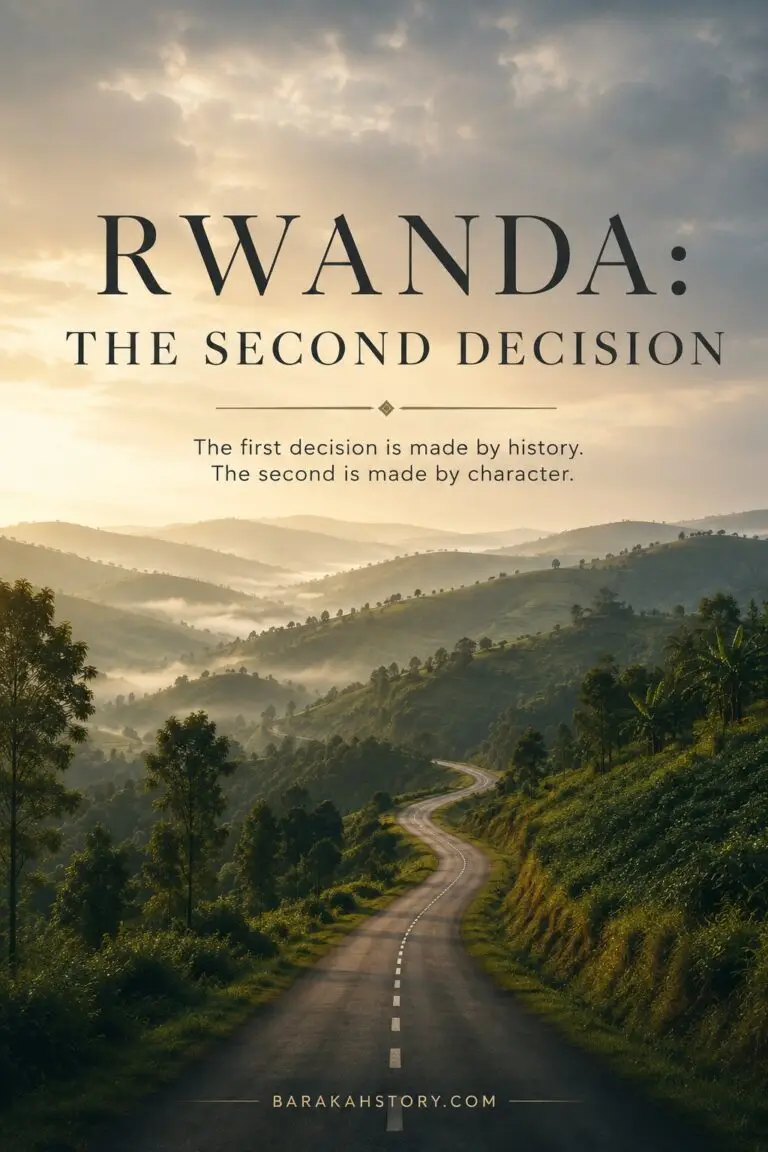
It becomes a story about the second decision.
The first decision is often made by history.
The second is made by character.
When the Past Refuses to Stay in the Past
After the genocide ended, Rwanda inherited a reality that no ordinary justice system could easily absorb.
The dead were gone.
The survivors remained.
The perpetrators were still part of the same society.
Villages could not simply be divided into places for victims and places for perpetrators.
Roads still crossed the same hills.
Markets still brought people together.
Children still grew up in communities carrying memories they had inherited from their parents.
The future, in other words, had to be built among people who could not escape the past.
This created a question more difficult than punishment:
How do you create a future when the past is still living among you?
That question sits at the heart of Rwanda’s reconciliation journey.
The ordinary courts could not process the extraordinary number of genocide-related cases quickly enough.
So Rwanda turned, in part, toward an older form of community justice.
Gacaca.
The word refers to a traditional community-based system in which people gathered to address disputes and wrong doing. After the genocide, Rwanda adapted this tradition into a mechanism for processing an enormous number of genocide-related cases.
The setting was striking.
Not the distance of a conventional courtroom.
The community.
People gathered.
Survivors spoke.
Witnesses testified.
Accused perpetrators faced the people who knew them.
Confessions could be heard.
Verdicts could be delivered.
By the time gacaca courts closed in 2012, they had processed almost two million cases.
That scale matters.
But numbers alone do not explain what Rwanda reconciliation was attempting.
Gacaca brought justice back into the same social landscape where the violence had occurred.
The people who had to continue living together were being asked to confront what had happened among them.
This is what makes reconciliation in Rwanda so difficult to understand through the language of punishment alone.
The question was not only:
Who should be held accountable?
It was also:
How can people who have been separated by violence ever inhabit the same future again?
But the story is not simple.
Gacaca was neither a perfect model of justice nor a failure that can be dismissed.
It was deeply human.
There were survivors who found answers about what had happened to their loved ones.
There were perpetrators who were brought before their communities.
There were also accusations of unfair trials, intimidation, corruption, and disputed verdicts.
That complexity matters.
Because reconciliation should never require us to romanticize history.
A civilization does not become morally serious by pretending its solutions were perfect.
It becomes serious when it can look directly at what happened-
including what worked,
what failed,
and what remained unresolved.
Justice Is Not the Opposite of Reconciliation
There is a temptation, when looking at reconciliation in Rwanda, to imagine that justice must eventually step aside.
Rwanda complicates that assumption.
The country did not begin by saying:
Forget what happened.
It began by confronting what happened.
There had to be testimony.
There had to be accountability.
There had to be recognition of wrongdoing.
There had to be memory.
Because reconciliation without truth can become another form of silence.
And silence is not always peace.
Sometimes silence is simply pain that has been denied a language.
This is where the idea of the second decision becomes important.
The first decision is what happened.
The second is what we allow what happened to produce.
A wound can produce vigilance.
It can produce wisdom.
It can produce justice.
But it can also produce hatred.
And hatred has a peculiar power.
It can make the past permanent.
It can take an event that lasted one hundred days and give it a life that stretches across generations.
The tragedy happened once.
Hatred can make it happen again-
inside the next generation.
This is why justice and reconciliation in Rwanda cannot be understood as competing ideas.
Justice addresses what happened.
Reconciliation asks what happens next.
They are different questions.
Both matter.
Remembering and Reconciliation in Rwanda
Rwanda did not choose forgetting.
Every year, the country enters Kwibuka, a period of remembrance commemorating the 1994 Genocide against the Tutsi. The commemoration lasts one hundred days, echoing the period of the genocide itself.
The word Kwibuka means “remember.”
There is something profound in that.
Because remembrance is not merely about looking backwards.
It is about deciding what must not disappear.
Names matter.
Stories matter.
The dead matter.
Truth matters.
A civilization that forgets its victims risks making their suffering invisible.
But there is another danger.
Memory can become a prison when it is transformed into permanent hatred.
This is where Rwanda’s story becomes psychologically interesting.
To remember is necessary.
To remain trapped inside what is remembered is another thing.
The distinction is subtle.
A healthy memory says:
This happened.
A destructive memory says:
This must continue happening through us.
The first protects truth.
The second reproduces the wound.
This is one of the deepest tensions within post-genocide Rwanda.
A society must preserve memory without allowing memory to become the only identity available to the generations that follow.
That is why remembrance and reconciliation do not have to be enemies.
Remembering says:
We will not erase the truth.
Reconciliation asks:
We will not allow the truth to destroy every possibility of tomorrow.
This is one of the quietest dimensions of Rwanda reconciliation.
It does not ask memory to disappear.
It asks memory to serve truth without becoming the author of every future relationship.
The Second Decision
History remembers the first decision.
Civilizations are shaped by the second.
The first decision may be made in violence, fear, propaganda, political manipulation, hatred, or collective madness.
But the second comes later.
It arrives when the blood has dried.
When the world has moved on.
When survivors must wake up the next morning.
When children are born who did not cause the tragedy but will inherit its consequences.
That is when character begins to reveal itself.
Because a civilization cannot change what happened yesterday.
But it can decide what yesterday will become tomorrow.
Some wounds become walls.
Others become bridges.
Some memories become weapons.
Others become warnings.
Some societies rebuild their cities.
Others have to rebuild relationships.
Rwanda reconciliation had to hold both together.
But rebuilding relationships is harder.
A destroyed building can be measured.
Trust cannot.
A road can be reconstructed.
A human relationship cannot simply be rebuilt with materials and machinery.
It requires something less visible:
truth,
time,
dignity,
and the possibility that another human being can become something different from what they once were.
That possibility is difficult to hold.
Especially when the past gives you reasons not to.
This is the deeper meaning behind Rwanda’s reconciliation journey.
It was never simply about making people forget.
It was about creating enough space for a society to exist beyond the moment that nearly destroyed it.
What Forgiveness Actually Requires
This is where Rwanda reconciliation touches something larger than Rwanda.
And this is where the Islamic worldview offers a deeper language for what reconciliation asks of the human being.
In the Qur’an, forgiveness is not presented as moral weakness.
Nor is it presented as permission for wrongdoing.
Allah says:
“The repayment of an evil deed is one equal to it. But whoever pardons and makes reconciliation, then their reward is with Allah.”
(Qur’an 42:40)
Notice the order.
The verse does not deny justice.
It acknowledges that an evil deed has a consequence.
Then it opens another possibility:
fa-man ‘afā wa aṣlaḥa–
whoever pardons and makes reconciliation.
Forgiveness is connected here with islah–
repair.
Reconciliation.
Putting something back toward what is right.
That distinction matters.
Because ‘afw is not simply forgetting.
It is not pretending that the wound never existed.
And it is certainly not declaring that injustice was acceptable.
Forgiveness becomes transformative when it refuses to allow wrongdoing to dictate the moral character of what comes next.
The Qur’an therefore gives us a way of seeing something Rwanda’s experience makes painfully visible:
justice may determine what is owed for what happened.
Forgiveness asks what we will carry forward from it.
The two questions are not identical.
And perhaps they were never meant to be.
This is where an Islamic reflection on Rwanda reconciliation becomes meaningful-not because Rwanda’s history is an Islamic story, but because the human question beneath it is one the Qur’an addresses directly.
What do we do with what has been done to us?
What do we preserve?
What do we release?
And what kind of person do we become in the process?
The Heart Cannot Build Tomorrow While Worshipping Yesterday
There is another verse that deepens this understanding.
In Surah An-Nur, Allah says:
“Let them pardon and overlook. Would you not love that Allah should forgive you?” (Qur’an 24:22)
The verse does something deeply human.
It connects the act of forgiving another person with our own longing to be forgiven.
It moves forgiveness away from superiority.
We do not forgive because we are morally above everyone else.
We forgive while knowing that we too stand in need of Allah’s forgiveness.
And yet Islam does not ask the wounded to deny their wound.
The Qur’an does not tell people to call injustice justice.
It does not tell societies to erase accountability.
It does not tell victims that remembering is a failure of faith.
Instead, it holds two realities together:
justice protects what is right.
forgiveness protects what remains human.
This is why the Islamic lens does not sit at the end of Rwanda’s story as a conclusion added from outside.
It helps us see the deeper question beneath the story.
Not simply:
Should we punish or forgive?
But:
How do justice and mercy prevent a wound from becoming a civilization’s identity?
That question reaches beyond Rwanda.
It reaches into the architecture of the human heart.
The Courage Behind Rwanda Reconciliation
This may be one of the deepest tensions within Rwanda’s reconciliation journey.
Reconciliation does not mean that pain disappears.
Some wounds never disappear.
Nor should they.
Memory protects truth.
Justice protects dignity.
But a civilization cannot live forever inside its deepest wound.
At some point, another decision must be made.
Not whether the past happened.
That decision has already been made by history.
But whether the past will be allowed to become the author of everything that follows.
That is the second decision.
And it is not unique to nations.
We make it in our homes.
As parents.
As spouses.
As friends.
As leaders.
Someone hurts us.
Someone disappoints us.
Someone betrays our trust.
The first decision belongs to the event.
The second belongs to us.
Will we carry the wound as wisdom-
or as identity?
Will we establish boundaries and justice-
without becoming consumed by hatred?
Will we remember-
without allowing memory to poison every future relationship?
Will we forgive-
not because what happened was small,
but because our future is too valuable to surrender to it?
These are not easy questions.
Rwanda does not offer an easy answer.
It offers something more valuable:
a civilization attempting to live with the question.
What Survives the Wound
The strongest civilizations are not necessarily those that avoid tragedy.
History has never offered that guarantee.
They are revealed by what they do with what cannot be undone.
Rwanda’s story cannot be reduced to reconciliation.
It contains grief.
Justice.
Memory.
Failure.
Political complexity.
Unanswered questions.
And the voices of people whose experiences do not fit neatly into a single narrative.
That is precisely why the story matters.
Real reconciliation is not clean.
It is not cinematic.
It does not erase contradictions.
It is built slowly inside the difficult space between what cannot be changed and what still can.
The past remains.
The dead remain remembered.
Justice remains necessary.
And yet-
the future remains open.
In the Qur’an, Allah does not simply praise the one who pardons.
He connects pardon with islah-reconciliation, repair.
That distinction matters.
Because forgiveness that merely suppresses pain may not heal.
But forgiveness that participates in repair can change what the pain produces.
This is perhaps what radical reconciliation means at its deepest level.
Not that the wound was insignificant.
But that the wound will not be given the authority to decide the future.
Rwanda reconciliation makes that tension visible.
A nation can remember without living entirely inside remembrance.
It can pursue justice without making vengeance its permanent identity.
It can speak of reconciliation without pretending that every wound has disappeared.
That is a far more difficult achievement than simply saying:
We have moved on.
A story like Rwanda may begin far from where we live.
But the question it leaves behind does not belong to Rwanda alone.
We know what it means to be hurt.
To remember.
To struggle with trust.
To decide whether something that happened to us will become part of our identity-
or simply part of our history.
The scale may be different.
The wound may be different.
But the second decision still comes.
Inside families.
Inside friendships.
Inside marriages.
Inside leadership.
Inside ourselves.
What happened to us is part of our story.
But it does not have to become the author of everything that comes after it.
That is why the story of reconciliation is never only about reconciliation.
It is about character.
About what remains when the past cannot be changed.
About what we choose to carry.
And what we finally choose to release.
From home to the world.
See the world.
See the inner world.