
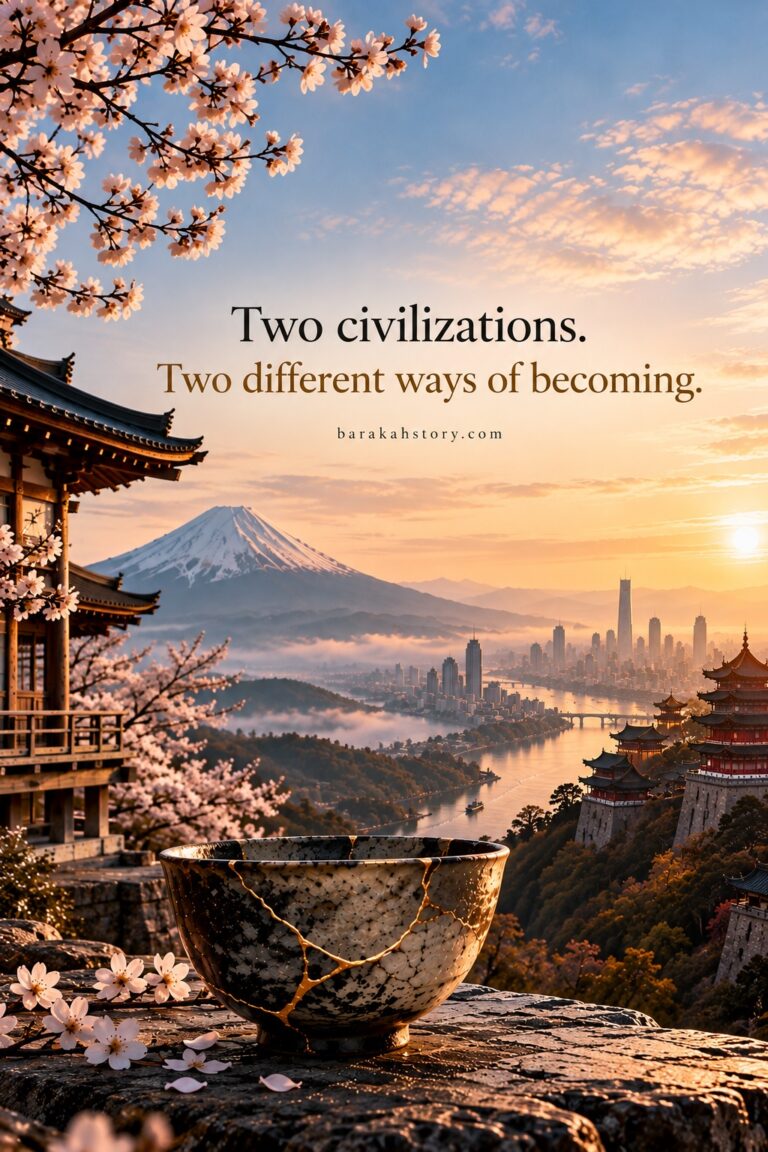
What We Do with What We Inherit
Bismillah…
Japanese and Chinese civilizations offer two distinct perspectives on how history, inherited knowledge, and human character shape the art of becoming.
There are things we inherit without choosing them.
A history. A language. A wound. A way of seeing the world.
A discipline formed long before we arrived.
Knowledge gathered by people whose names we may never know,
yet whose work continues to shape the lives we live today.
We enter a story already in progress.
But inheritance is not the end of the story.
What came before us matters, sometimes profoundly.
It shapes the ground on which we stand, the possibilities we can see,
and the questions we learn to ask. Yet it does not determine everything that follows.
Something else enters the story: what we choose to do with what has been placed in our hands.
Japan and China offer two distinct ways to contemplate this question.
In Japan, the story of becoming leads us toward the broken object,
the visible fracture, and the painstaking work of repair.
In China, it leads us toward knowledge accumulated across generations, learning carried forward,
and the transformation of knowledge into capability.
One invites us to look closely at what has been damaged.
The other asks us to consider what can be built from what has been learned.
Neither story is simple, and neither civilization can be reduced to a single characteristic.
Yet, when observed through these particular histories and practices,
both open a deeper question about human development:
What happens to what we inherit when it passes through us?
Japan: When a Fracture Becomes Part of the Story
Long before Hiroshima became a defining memory in modern Japanese history, Japan had a tradition of repairing broken pottery with lacquer and precious metal.
Known as kintsugi, the practice does not attempt to make a damaged object appear untouched. The fracture remains visible. The repair becomes part of the object’s appearance, sometimes traced with gold.
The object is no longer exactly what it was before it broke.
But it is not simply an object that failed, either.
Its history has become visible.
There is something compelling about this way of seeing damage.
A fracture does not have to be concealed for an object to retain its worth. Repair does not require pretending that nothing happened. What has been broken can be restored to use without erasing the fact of its breaking.
Kintsugi is a particular craft, not a universal explanation of Japanese culture. Yet it offers a meaningful point of entry into a broader reflection on how we respond to what cannot be returned to its original condition.
Then history presented Japan with a devastation far beyond the scale of a broken vessel.
In August 1945, atomic bombs destroyed Hiroshima and Nagasaki.
Lives were lost on an immense scale. Families were shattered. Cities were devastated. The consequences extended beyond the immediate destruction, entering the bodies, memories, and futures of those who survived.
No metaphor of repair can adequately contain such suffering. The devastation of war must not be romanticized as though catastrophe were simply an opportunity for renewal.
And yet, in the decades that followed, Japan rebuilt while preserving places and practices through which the destruction could be remembered.
The Atomic Bomb Dome in Hiroshima remains a visible witness to the bombing. Memorials preserve the names and experiences of victims. Peace has become an enduring part of Hiroshima’s public memory and international message.
The past was not made harmless by being remembered. Nor did rebuilding mean that the loss had been undone.
Instead, Japan’s postwar story reveals a difficult distinction: to rebuild is not necessarily to erase; to continue living is not to declare that nothing was lost.
The fracture remains part of the story.
This does not mean that every wound becomes wisdom, or that every suffering finds a satisfying resolution. Some losses cannot be repaired in the ordinary sense. Some memories remain painful. Some consequences continue across generations.
But there is a difference between allowing the past to disappear from view and allowing it to inform what comes next.
A wound can be carried as an unexamined inheritance, shaping every response without our awareness. It can also become something we learn to understand, confront, and respond to with greater care.
The past cannot always be changed.
Our relationship with it, however, can develop.
This is where the image of kintsugi becomes more than an aesthetic curiosity. It invites us to consider what repair actually asks of us. Not the performance of being unbroken, but the patience to work with what remains. Not the denial of history, but the responsibility to decide what kind of future we will build in its presence.
Refinement begins with attention.
We must first see what is there before we can decide what deserves to be repaired, preserved, or transformed.
China: When Knowledge Becomes Capability
China offers a different point of entry into the art of becoming.
Its long history contains dynastic changes, periods of flourishing, conflict, foreign invasion, revolution, and profound political transformation. No account of Chinese civilization can be reduced to an uninterrupted story of progress. Its history includes ruptures, losses, and contradictions as well as extraordinary achievements.
Yet across many periods of this history, the transmission of knowledge, the place of education, and the work of building institutions have occupied important positions in Chinese intellectual and social life.
Knowledge was not only something to possess. It could be studied, organized, transmitted, tested, and developed by those who came after.
The significance of this inheritance lies not merely in what one generation knew, but in what another generation could do with it.
The histories of Japanese and Chinese civilizations remind us that inheritance gains lasting significance when what is received becomes something the next generation can understand, practise, and develop.
A body of knowledge can remain in books. A technique can disappear when its practitioner is gone. An insight can be admired without ever changing how anyone works.
Knowledge becomes a different kind of inheritance when people learn to carry it into practice.
A method is repeated. A skill is developed. A process is improved. An institution enables learning to extend beyond one individual. A discovery becomes the foundation for another discovery.
Over time, what one generation has learned can become the starting point for work that the previous generation could not yet accomplish.
This movement-from knowledge to practice, from practice to capability, from capability to more complex forms of mastery-offers a useful lens through which to examine aspects of China’s modern development.
Its expansion in manufacturing, infrastructure, telecommunications, electric vehicles, battery production, high-speed rail, artificial intelligence, advanced manufacturing, and space technology demonstrates how technical knowledge can be developed at scale through education, investment, institutional capacity, and sustained execution.
These achievements do not emerge from knowledge alone. They also depend on resources, policy, organization, markets, infrastructure, and many other conditions. Nor does technological advancement automatically resolve every social, ethical, or human question.
But the underlying distinction remains important.
Knowing what is possible is not the same as developing the capability to make it possible.
Between the two lies a long process: learning, practice, coordination, correction, and the accumulation of competence.
This is one of the most consequential things Japanese and Chinese civilizations can help us examine: what a civilization passes forward is not merely a collection of achievements, but also the capacity to keep learning.
The inheritance becomes powerful when it no longer depends entirely on the person who first acquired it.
It enters a system of learning and practice, where others can carry it further.
This is mastery understood not as a moment of personal brilliance, but as a discipline sustained across time.
Japanese and Chinese Civilizations: Two Distinct Questions
Japan and China are not opposites, and their histories cannot be contained by a neat division between refinement and mastery. Both have traditions of learning, craft, technological achievement, and collective effort. Both contain complexity that exceeds any single interpretation.
Still, the particular narratives explored here reveal different emphases.
The histories of Japanese and Chinese civilizations reveal different ways of responding to inheritance: one invites reflection on repair and historical memory, while the other illuminates the relationship between learning, practice, and mastery.
Japan invites us to examine the relationship between damage, attention, memory, and repair. Its story asks what can be done when something has been changed irreversibly-and whether rebuilding can preserve the truth of what happened.
China invites us to examine the relationship between knowledge, transmission, disciplined practice, and capability. Its story asks how what one generation learns can become the foundation for what another generation is able to accomplish.
One draws our attention toward the fracture and the care required to work with it.
The other draws our attention toward the accumulated knowledge and effort through which new possibilities become achievable.
These are not fixed national identities. They are interpretive lenses grounded in particular aspects of history and practice.
Their deeper connection lies in what both reveal about time.
Neither repair nor mastery appears fully formed.
A repaired object carries the evidence of work performed patiently. A sophisticated capability carries the accumulated effort of people who learned, practiced, corrected, and built before it became visible as an achievement.
What appears accomplished in the present often contains a long history of repetition.
And repetition does something more than improve an object or a skill.
It shapes the person who repeats it.
What We Repeat Becomes Part of Who We Are
A person may inherit a family wound without choosing its origin. Yet the way that person responds to conflict can determine whether the wound is passed forward unchanged or met with a different kind of understanding.
A person may inherit knowledge without being responsible for discovering it. Yet what that person does with the knowledge determines whether it remains information or develops into competence.
The same distinction appears in the work we undertake, the relationships we maintain, and the responsibilities we accept.
We may know what patience requires and still respond impatiently.
We may understand the value of honesty and still make exceptions when dishonesty becomes convenient.
We may possess knowledge without applying it, talent without cultivating it, or responsibility without giving it the attention it deserves.
What we know matters. What we repeatedly practice reveals another dimension of us.
A single action can be an exception. Repeated actions begin to form a pattern. Patterns influence how we respond when circumstances change, when pressure rises, and when no one is present to remind us what matters.
Eventually, what once required deliberate effort can become part of our ordinary way of being.
Across Japanese and Chinese civilizations, the practices carried forward through generations also invite us to examine how repetition shapes collective character.
This is one reason civilizational inheritance cannot be understood only through monuments, technologies, manuscripts, or institutions. These are visible expressions of something carried by human beings: habits of attention, ways of learning, standards of work, and assumptions about what deserves to continue.
A civilization passes forward more than its achievements.
The histories of Japanese and Chinese civilizations show how inherited ways of thinking,
learning, and working can shape the character of future generations.
The same is true of families, organizations, and individuals.
A founder leaves behind more than a company. The founder’s decisions may establish habits of leadership, standards of integrity, or a tolerance for shortcuts that continue long after the founder has left.
A parent passes forward more than advice. Children also observe how responsibility is carried, how mistakes are acknowledged, how other people are treated, and what happens when doing the right thing becomes inconvenient.
A writer leaves behind more than pages. The work can carry a way of seeing, a discipline of thought, and a standard of care that readers may continue to develop in their own lives.
In each case, inheritance becomes consequential through what people do with it.
The question is no longer only what has been received.
It is what is being made of it.
The Islamic Lens: Ihsan, Itqan, and the Trust of What We Carry
Islam deepens this question by placing human effort within a larger understanding of existence.
Our lives do not begin with absolute ownership. We receive time we did not create, abilities we did not independently bring into existence, opportunities shaped by circumstances beyond our control, and responsibilities that cannot always be transferred to someone else.
The Qur’an repeatedly turns our attention toward the nature of our deeds-not only their visibility, scale, or worldly result.
Allah says:
“He who created death and life to test you as to which of you is best in deed.”
The verse directs our attention toward the quality of what we do. The question is not simply how much we produce, how far we advance, or how impressive our achievements appear. There is a deeper question concerning the deeds themselves: what kind of action are we bringing into the world, and what does it reveal about the way we have responded to our lives?
This is where ihsan and itqan offer two related but distinct dimensions of reflection.
Ihsan concerns excellence in its deeper moral and spiritual sense: worshipping Allah with awareness of Him, and allowing that awareness to inform the way we conduct ourselves. It changes the meaning of responsibility. What we do is not separated from the One before whom we live, even when our work appears ordinary or remains unseen by other people.
Itqan speaks to doing work with soundness, care, and competence. It draws attention to the integrity of the work itself: whether we have approached it conscientiously, whether we have developed the ability it requires, and whether we have given it the attention appropriate to its purpose.
These concepts are not labels to attach to Japan or China. Their traditions do not stand as substitutes for Islamic guidance, and their achievements do not establish the measure of a person’s standing before Allah.
Rather, the two histories provide occasions for reflection.
The histories of Japanese and Chinese civilizations become meaningful points of reflection when we consider not only what they achieved, but how human beings respond to what they inherit.
Kintsugi directs our attention toward how we respond to what has been damaged. The transmission of knowledge in China directs our attention toward how we cultivate what has been entrusted to us and carry it into practice.
Islam asks us to take the inquiry further.
What is the quality of our response to what Allah has placed in our hands?
A person may become highly skilled while neglecting justice. An organization may achieve extraordinary efficiency while treating people as expendable. A society may accumulate knowledge without allowing that knowledge to cultivate wisdom or moral responsibility.
Capability alone does not guarantee goodness. Refinement alone does not guarantee righteousness.
The Islamic lens holds excellence and accountability together. Our work matters, but so do our intentions, our conduct, the means by which we pursue our aims, and the effects of our actions on others.
Ihsan prevents excellence from becoming merely an outward performance. It returns the heart to its relationship with Allah and asks whether our actions are worthy of that awareness.
Itqan reminds us that sincerity is not an excuse for carelessness. When a responsibility has been entrusted to us, good intentions should move us toward the knowledge, preparation, and disciplined effort required to fulfil it well.
The two are not interchangeable, but they belong in the same conversation.
One directs us toward the spiritual and moral quality of our relationship with Allah and His creation. The other brings attention to the care and competence with which a task is carried out.
Together, they challenge the idea that achievement is the final measure of becoming.
A more difficult question remains: what kind of human being is being formed through the pursuit of that achievement?
The Things We Choose to Carry Forward
Not everything we inherit deserves to continue unchanged.
Some things require repair. Some require deeper understanding. Some require disciplined practice before they can become useful. Some must be left behind because carrying them forward would only reproduce harm.
This discernment is part of our responsibility.
A painful history should not be denied, but neither should it be allowed to excuse every future response. Knowledge deserves to be preserved, but preservation alone is insufficient if we refuse to learn from it. A tradition may contain wisdom, yet carrying it responsibly also requires understanding what it means and how it should be lived.
Inheritance is not passive.
We participate in it through the choices we make, the habits we cultivate, the standards we uphold, and the things we permit to become normal.
The histories of Japanese and Chinese civilizations remind us that inheritance takes different forms: Japan’s story of repair shows that the past need not be erased for life to continue, while China’s tradition of learning and its modern development reveal how knowledge becomes consequential when people carry it into practice and build upon what came before.
Neither story promises that becoming will be easy. Neither removes the contradictions of human history. But both invite us to look beyond the finished result and consider the long process through which something becomes what it is.
This reflection reaches beyond nations.
What have we inherited from our families that deserves understanding before it is passed to our children?
What knowledge have we received that deserves more than admiration?
What ability remains undeveloped because we have mistaken potential for accomplishment?
What wound continues to shape our decisions because we have never examined the way we carry it?
And what have we made so habitual in our lives that we no longer notice the person it is forming?
These questions do not ask us to become someone else. They ask us to become more conscious of the work already before us.
To refine what needs greater care.
To develop what deserves mastery.
To preserve what carries wisdom.
To change what perpetuates harm.
And to remember that the things entrusted to us are not only resources for our own advancement. They also carry responsibilities toward the people who live alongside us and those who will come after us.
Japanese and Chinese Civilizations: The Art of Becoming
The most important part of inheritance is not what remains in our possession, but what becomes possible because it passed through our hands.
A repaired object can continue its life without pretending it was never broken.
Knowledge can travel beyond its original owner and become the foundation for work not yet imagined.
A family can inherit pain without making pain its permanent language. A leader can inherit an institution without repeating every habit that shaped it. A person can receive an ability and choose to cultivate it into something that serves beyond the self.
None of these outcomes happens through inheritance alone.
They require attention, discernment, effort, and a willingness to take responsibility for what comes next.
This is where the histories of Japanese and Chinese civilizations meet-not because they teach an identical lesson, but because their different experiences bring us toward the same human question.
What do we do with what we inherit?
And, more quietly, what are we becoming through the way we do it?
The answer is written not only in the achievements that others can see, but in the habits we repeat when no one is watching; in the care we bring to ordinary responsibilities; in the knowledge we choose to develop; in the wounds we refuse to pass forward unchanged; and in the standards we uphold when lowering them would be easier.
In the Islamic understanding of life, this work takes place within an amanah: a trust for which we remain accountable to Allah. We do not control every circumstance we receive, and we cannot guarantee every outcome of our effort. But we are responsible for how we respond within the limits and opportunities given to us.
Becoming, then, is not a project of endless self-invention. Nor is it the pursuit of perfection for its own sake.
It is the patient work of responding more faithfully to what has been entrusted to us.
Some things we must learn to repair.
Some things we must learn to master.
Some things we must have the courage to stop carrying forward.
And some things, through careful practice and sincere intention, we may leave in better hands than the ones in which we received them.
What we inherit does not fully define us. What we do with it matters.
The art of becoming lies in that space between what has been given and what we choose to make of it-before Allah, within our own lives, and in the lives of those who will inherit what we leave behind.